



Your cart is empty !
It's flat around here...
Until recently, the most direct path between two waves was efficient paddling ;) Today you can fly from one wave to another!
A revolution in the world of surfing and a shift in effort from arms to leg. Flying a surf foil isn’t a free ride in terms of physical effort though. To efficient paddling succeeds efficient pumping. Here are the key points to connect waves in surf foiling.
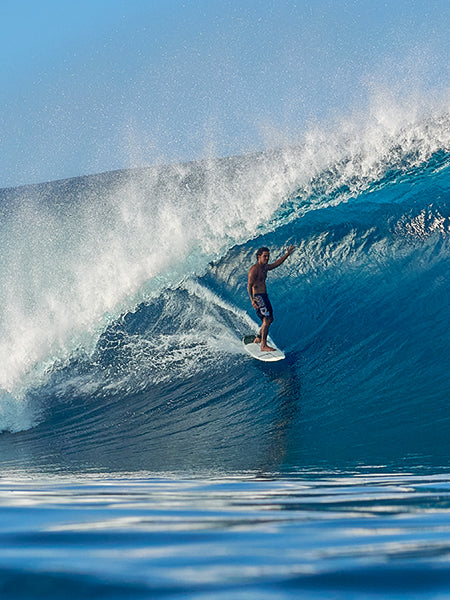
 Surf foiler: Malo, GONG team rider, on his Lemon FSP Pro, HM77 mast, Fluid front wing and Ypra Surf-Freestyle stabilizer.
To have the best chance of connecting a wave, exiting the wave with speed is key. Pumping will be all the easier if you exit the wave with momentum. If you are flying high, everything’s easy. On the contrary, if you exit the wave slowly, the effort to pick up speed and raise your foil will be huge and will ruin your endurance, and therefore your chances of connecting. It is essential to capitalize on the speed generated on the wave and to maintain it.
The ideal wave for making a connection is one that gives you a clean exit, ideally with a slightly soft shoulder. That way, you get a wide open section that lets you maintain your speed without having to pump.
Note that exiting the wave on the shoulder also limits the chance of ventilating or stalling on foamy parts. Get out of the wave by turning wide enough not to break your speed, not to ventilate a tip and not to lose a very vertical attitude proper to a good pumping technique. The effort to straighten up is also a waste of energy.
 Surf foiler: Valentin, GONG staff, on his Matata FSP Pro, HM77 mast, Fluid front wing and Ypra Surf-Freestyle stabilizer.
Don't wait a second to pump when exiting the wave unless you're speeding or the lower of your foil is surfacing. The effort must be continuous to take advantage of your initial speed. Start pumping down from a high position, without going down excessively. The higher you are, the more you limit the drag of your mast. This is decisive for your speed. The more your mast is emerged, the less water you will have to push to move forward, which means less effort for more speed. Flying high also means less risk of a fatal touchdown.
 Surf foiler: Valentin, GONG staff, on his Matata FSP Pro, HM77 mast, Fluid front wing and Ypra Surf-Freestyle stabilizer.
Don't just lighten your foil. This is a common mistake when starting out. This technique only works with big front wings that lift at very low speed and quickly proves to be limiting. It does not allow you to travel a long distance and is more exhausting.
To maintain your speed, you also have to project yourself forward. Focus on the idea of sinking the front wing into the water. That is to say, put a lot of pressure on it with the front foot while projecting yourself forward, therefore tilting your chest and shoulders forward. Take a look at Marvel’s Silver Surfer, you have to have the same attitude ;-)
If you look carefully at our videos showing these pumping phases, you will see that the heel of the back foot constantly lifts off the board, because almost all the pressure is on the front foot. Keep in mind that the more you project yourself, the more you accelerate your foil, and it is this acceleration that will create lift. It is also this speed that will give you amplitude between each movement, the more speed you have, the more you lengthen the distance between each pumping movement. And the more these movements are spaced out, the more you are able to extend the distance to be covered. You have to look far away, focus on the swell you want to connect.
Crucial point: the strategy. If your goal is to connect, you must commit to a smart game plan for your level. For example if the sets are made of 5 waves you should catch the first one of the set close to the shore and aim for the following ones to connect. If you don't know how to get past the whitewater, positioning yourself offshore may help. Taking off on the shoulder of a bigger set wave is tricky but there won’t be any whitewater to cross… In any case, you must put in place a strategy. And it is this mixture of extreme physical effort, perfect glide and tactics that makes such sessions exciting.
 Surf foiler: David, GONG staff, on his Lemon EPS Pro, HM77 mast, Fluid front wing and Ypra Surf-Freestyle stabilizer.
The first rule is to avoid accidents at all costs. If someone is already surfing a wave, that wave is theirs when you fly towards the line-up. So like in surfing, you have to free the best part of the wave between the curl and the shoulder by passing either over the whitewater, behind that person, or very far on the unsurfable part of the shoulder. In any case, your choice of trajectory must be clear and obvious. Whoever surfs should not have to wonder what you’re doing: it's his wave. Be generous, don't connect every wave of every set. You can drop away from the crowds and so you should. No point in flying for 15 minutes in the middle of the line-up either. Leave the good sections to the surfers and cruise on the stretched out and unsurfable parts of the waves.
 Surf foilers: Beryl and Valentin, GONG staff, in Scura and Lemon FSP Pro, HM V3 masts and Curve and Fluid H V3 setups.
Finally, all this is in the ideal world of the perfect spot. The reality is sloppy and knee-high conditions on a take off zone too shallow for your mast, seaweed and whitewater to pass just when you've finally managed to fly up to speed... But that's precisely the beauty of this sport : making the magic happen.
If you have a good speed when exiting the wave, the pumping movement is almost limited to a succession of relief and pressure of your body towards the front of the foil. This relief can be accompanied by upward movement of your arms, but pay attention to the synchronization of movements between the upper and lower body. Limiting yourself to the lower body is generally more effective than gesticulating. Either way, the goal is to elevate your entire body and then compress the foil.
It is important to note that you must create an imbalance between the front and the back of your foil. Imagine that you make a plane do a small nose dive with each pumping stroke so that it accelerates. The trim of the foil must not remain horizontal but oscillate from bottom to top as you move forward. But don’t overdo it. In a perfect world, you just have to push down on your foil because by nature these profiles go forward. But that won't be enough, so you have to accelerate it when compressing and take advantage of the relief to bring it back up. In practice, the rear toe dominates the weight reduction effort and the outside of the front foot directs the compression. A bit like an ollie on a skateboard, to make a rough comparison.
If you couldn’t get out of the wave with enough speed, a simple succession of relief and forward pressure will not be enough to maintain flight. You must increase the amplitude and/or the pace. The physical effort then becomes very intense. In addition to managing the shift of your weight, you need good coordination of the flexion/extension sequence of your front and then back leg. You have to give it your all while avoiding the touchdowns. Projecting yourself visually forward by looking far ahead of you will help you. In addition, if nice swell lines rise, you’ll be fueled with extra energy ;)
Regarding the rhythm of compressions / reliefs, it will depend on the speed / natural lift of your foil, your momentum when exiting the wave, your physical condition, your personal qualities (more cardio or more muscular) etc... Everyone has its own rhythm.
Another very important point: breathe! Most people start pumping in apnea. Gesticulating has at least the advantage of setting a pace for breathing. We inspire going up and we expire going down, ideally. Keep this in mind, not breathing is kind of consequential ;)
 Surf foiler: Beryl, GONG staff, on his Scura FSP Pro, HM mast, front wing and Curve stabilizer.
The equipment plays a major role, so much so that you sometimes have to specialize: gear for connecting, or gear for doing maneuvers. With a Fluid, you get the best of both worlds, whereas with a Veloce you’ll be the king of pumping and gliding on the wave. And if you want to break connection records, a Sirus L is perfectly manageable in small waves and will carry you to infinity! Beginners will prefer an X-Over or Ascent foil for their forgiving nature. The Curve foil ideally bridges the gap between the forgiveness of these foils and the glide of the Fluid and Veloce.
 Surf foiler: Malo, GONG team rider, on his Matata FSP Pro, HM77 mast, Fluid front wing and Ypra Surf-Freestyle stabilizer.


2 comments
Cool
Bonjour
Super article !
Merci bcp
Pr ma part je pense etre au démarrage.. j arrive pas encore à connecter et aller au line up..
Je suis encore sur les sensations que procurent le foil..
J ai pris de belles boites..genre vague puissante qui m’a fait monter haut d entrée !! Et donc chute..
Gong surf matata.. ailes xover L
Avez vous plus d articles sur ce sujet !
À bientôt
Guillaume.