Your cart is empty!
It's flat around here...
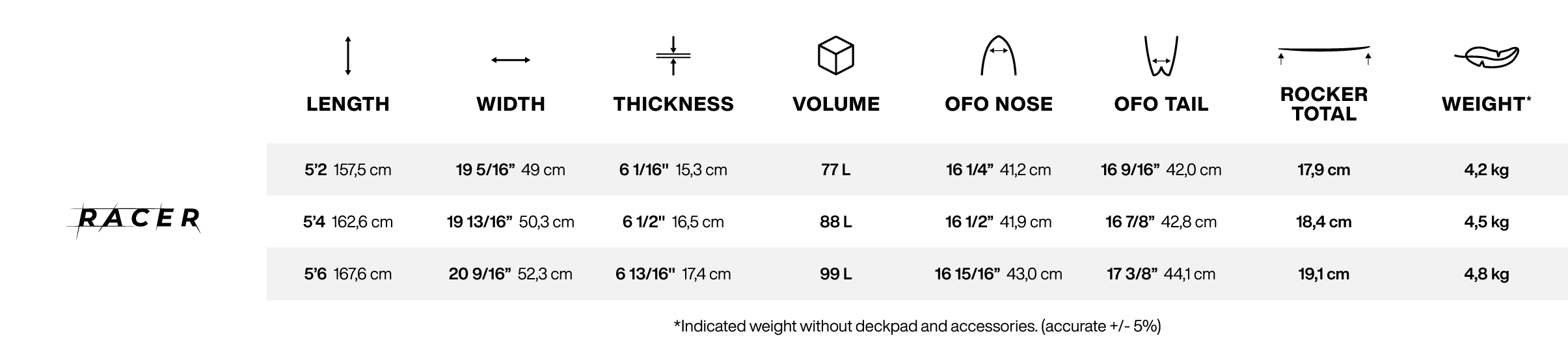

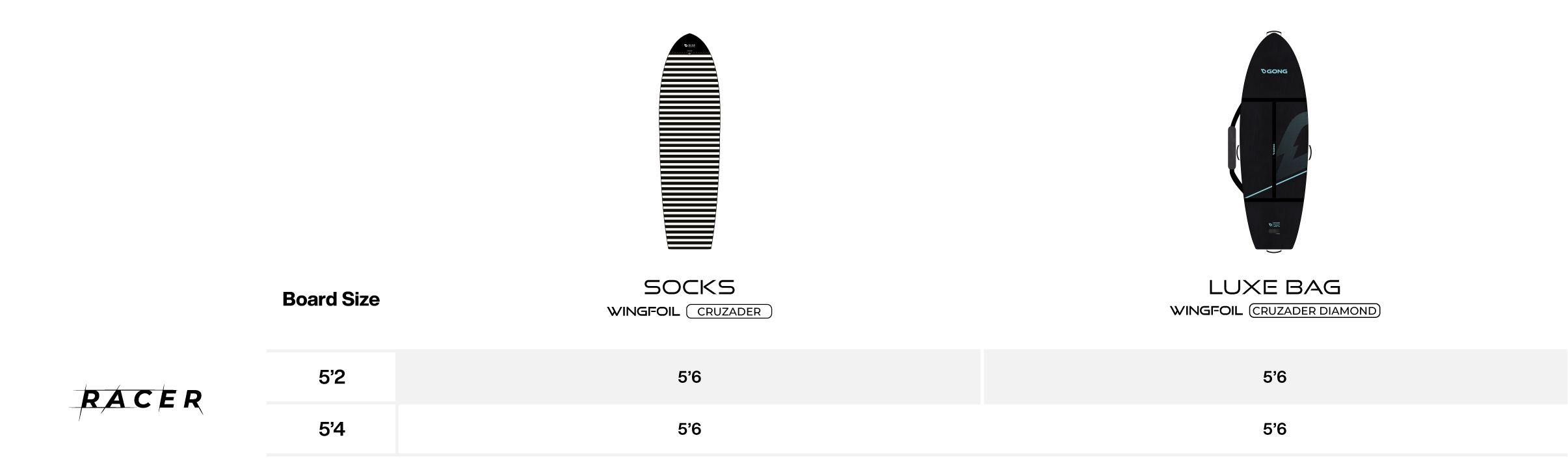


Course racing, slalom, long distance, freerace: the Racer is THE board for going fast, holding speed and staying in control when everything ramps up.
The Racer is the board built to chase speed, again and again.
Developed with the GONG Team, made up of multiple World and European Champions, it packs in everything you expect from a true race board: early take-off, hard acceleration, the ability to hold very high speeds and stay in control when the water state gets demanding.
In slalom as in long distance, every detail matters. The Racer is built to turn the slightest breath of wind into usable speed and let you stay competitive across a huge wind range. It gets going early, builds speed quickly and lets you use smaller, thinner and faster foils without sacrificing take-off.
Its feel is performance-oriented from the outset. Before take-off, it glides flat, accelerates cleanly and lets you get into the straps quickly. Once up and running, it becomes very free and very direct, with a level of control that makes you want to keep pushing.
At high speed, that’s where it really comes into its own. It stays composed through acceleration, absorbs trim errors better and lets you keep a lot of pressure on the front foot. You can load up the foil, hold your line and keep accelerating without ever feeling like the board is imposing a limit.
The rider stands right at the heart of the board, with a very direct connection to the foil. This position brings a lot of precision in speed build-up, fast gybes and those phases where a few tenths of a second make all the difference. The Racer responds instantly and remains perfectly readable, even when everything is happening fast.
The Hollow Full Carbon construction pushes this search for efficiency even further. Less weight and less inertia make the board livelier under acceleration, easier to reposition and more transparent once in flight.
The Griptoe Traction Pad delivers the grip needed to stay perfectly locked into the straps when you start riding really fast. At over 30 knots, that confidence in your footing lets you focus purely on your line, acceleration and the next reach.
From the low end to full-speed runs, the Racer is built for one thing only: going fast without ever having to back off.
It’s up to you to draw the line. The Racer gives you everything you need to hold it all the way.
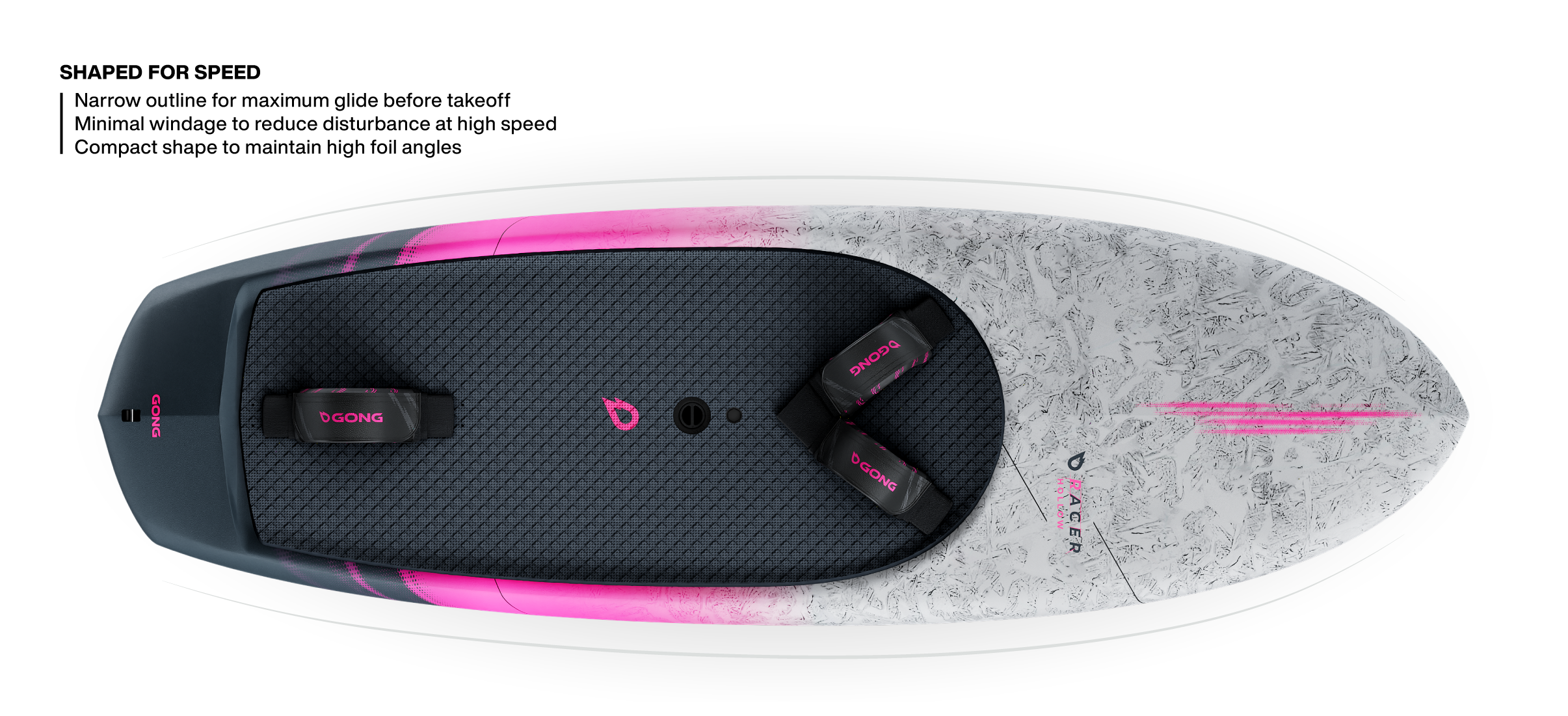
The long, very narrow outline reduces the Racer’s frontal area and maximises glide before take-off. The board accelerates easily, quickly builds the speed needed for take-off, and lets you make the most of small race foils.
This narrow width also reduces bulk when the foil is riding at a lot of angle. Upwind and in chop alike, the board stays well clear of the water and lets the rider hold their line without having to back off.
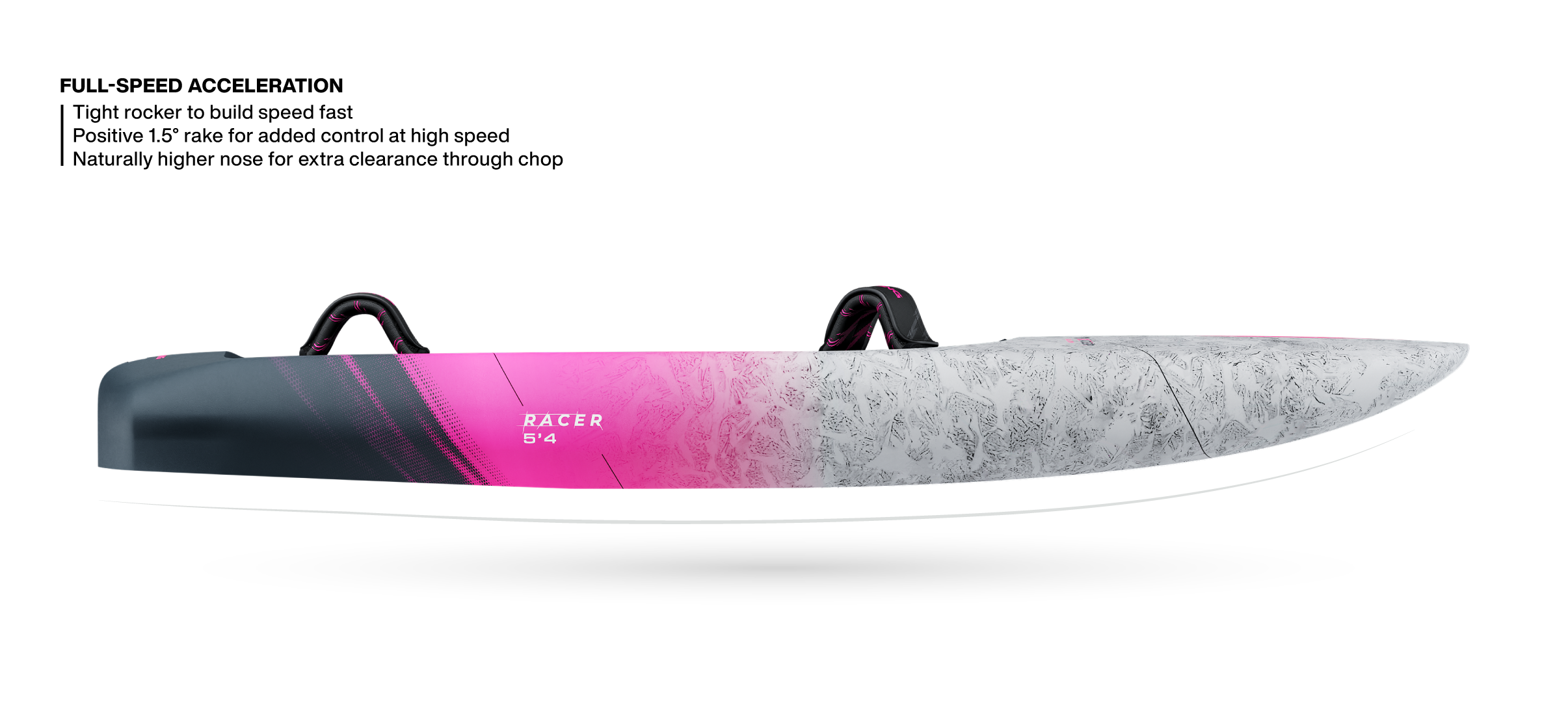
The very flat rocker gives the Racer planing glide close to that of a windsurf board. It accelerates quickly when flat and efficiently reaches the speed needed to lift off a small-area race foil.
The 1.5° positive rake built into the tail naturally lifts the nose once flying. The rider can keep more pressure on the front foot, with more margin in chop and during high-speed touchdowns.
The rear half of the hull is very flat and planing-oriented to deliver clean water flow and maximise speed before take-off. This surface quickly generates support on the water and makes take-off easier with the fast foils used in competition.
Up front, a V paired with a slight double concave smooths out contacts at full speed. The water is progressively deflected to each side to avoid abrupt deceleration and allow the board to stay on line.
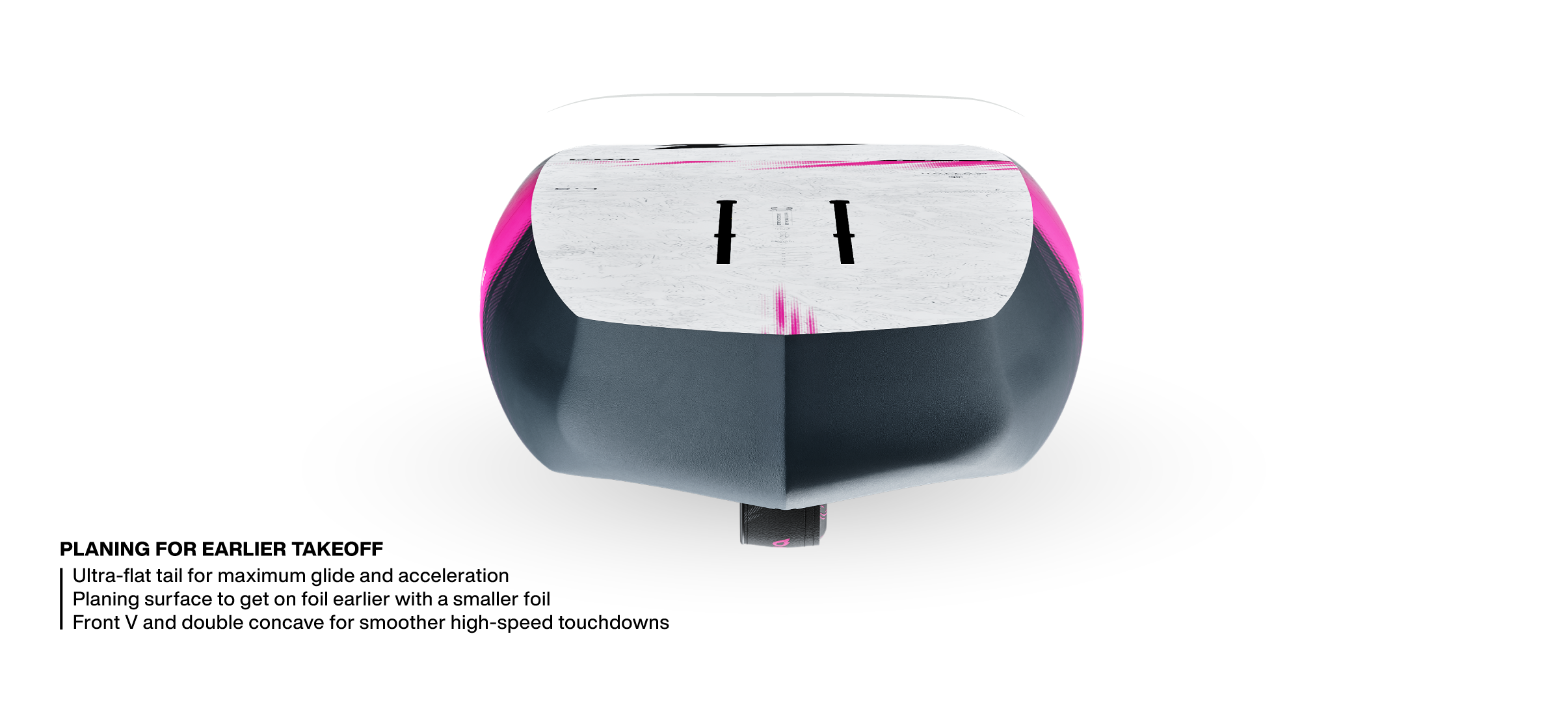
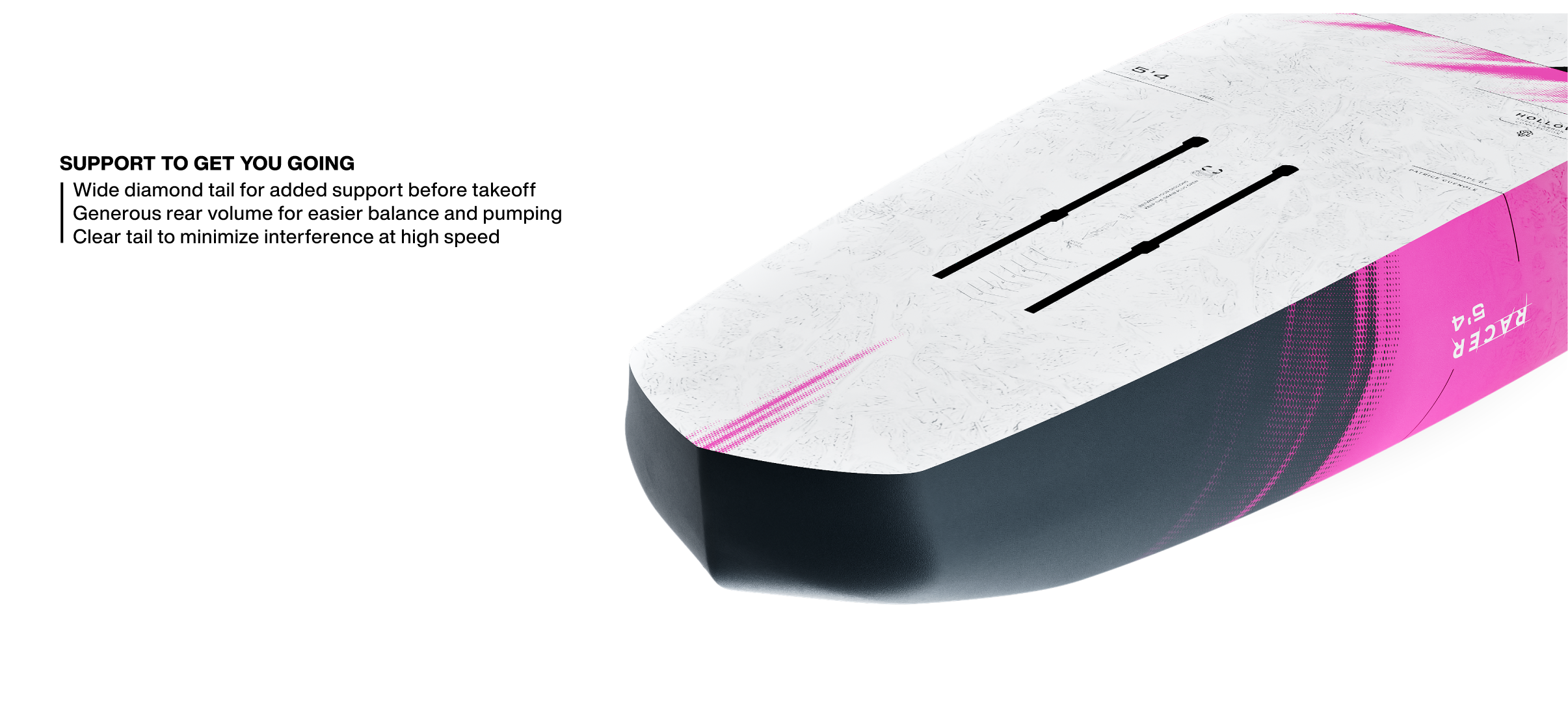
The wide, thick diamond tail concentrates a lot of support around the back foot. Before take-off, it stabilises the board, makes it easier to get into the straps and lets you really load up your stance to accelerate.
Its outline then narrows quickly to reduce bulk once flying. Combined with the flat rocker and integrated rake, it delivers plenty of glide on the water while keeping the necessary margin during a high-speed touchdown.
The rails are straight and sharp at the tail to deliver a very clean release. The water leaves the hull quickly, which increases glide and gives the Racer crisp acceleration from the very first planing phases.
They gradually become softer towards the front. In the event of a touchdown during a manoeuvre or in chop, the rails guide the contact rather than abruptly stopping the board, which helps maintain speed and control.
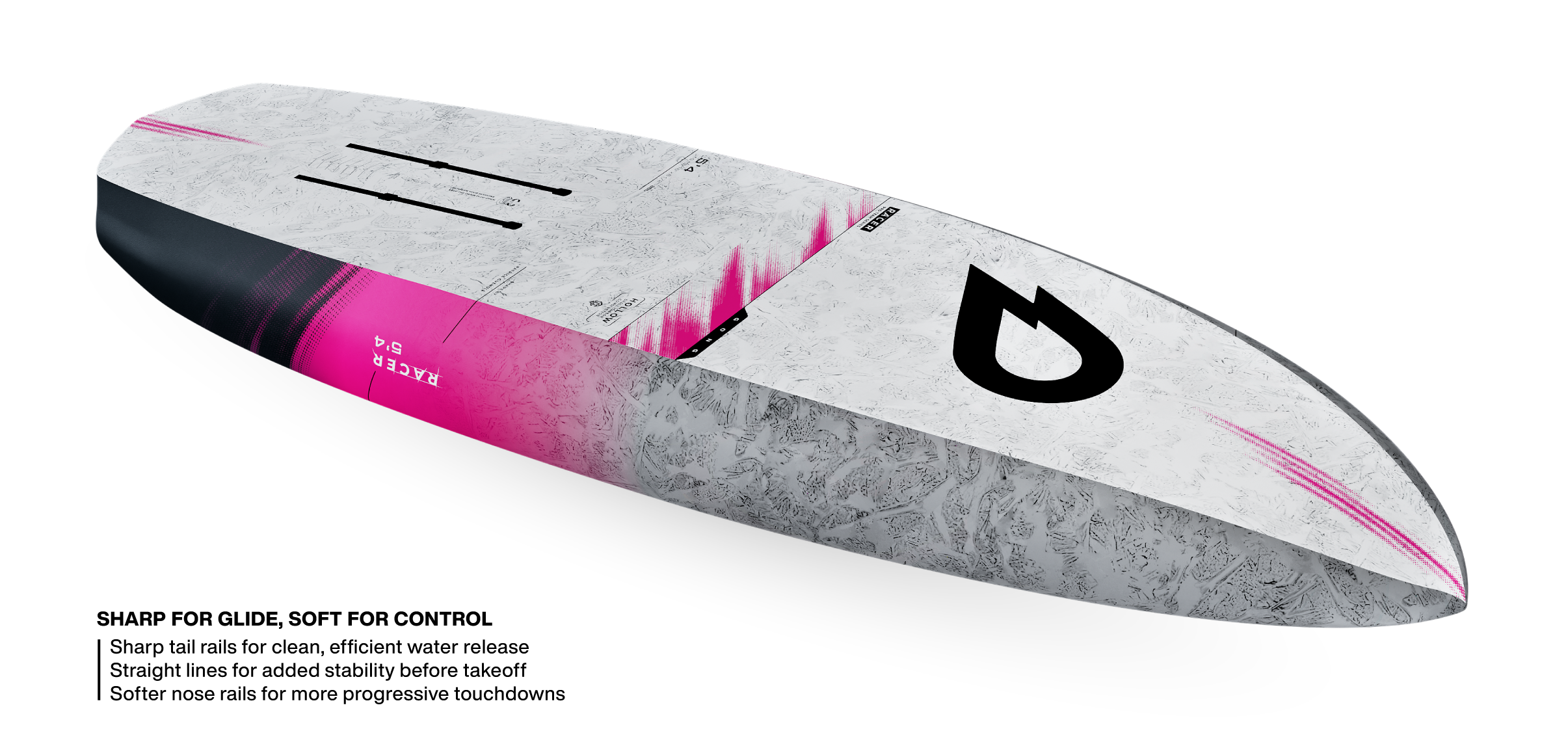
The slim semi-bow nose limits windage and reduces bulk in front of the rider. Its bulb provides the volume needed to balance the board when stationary without unnecessarily widening the front end.
The very rounded rails prevent any hard edge from catching the water at high speed. Combined with the bulb and the hull work, they allow the nose to skim and bounce during a touchdown rather than burying abruptly.
The Racer is aimed at riders who already have a good level in wing foiling and want to push their performance in speed and racing.
Its very narrow width is directly linked to its purpose: maximise glide, reduce windage and allow you to hold a lot of angle at high speed. This slim shape naturally requires more balance before take-off than a wider board.
With generous volume, it remains relatively accessible for a race board. With volume close to or below your weight, the kneeling phases in chop become more technical and require solid reflexes as well as good fitness.
It is clearly the board for anyone who wants to make the most of the wing and foil’s full potential in racing, slalom and speed.
The Racer is a pure slalom, race, speed and long-distance board, designed to perform across an extremely wide range of conditions.
Its job is simple: go fast without having to fight the board.
In light wind, it glides flat, stays well balanced and lets you position yourself quickly to make the most of the slightest puff. Its efficiency before take-off makes it possible to lift off with very small race foils, including below 550 cm², without having to wait for a big gust.
As speed builds, its compact outline, pitch control and forgiveness through touchdowns let you keep pushing. It is just as comfortable hunting for early take-off in very light wind with a big wing as it is holding a committed line at very high speed.
Early take-off, acceleration, control and Vmax: its entire programme is geared towards the clock.
The Racer is designed to get the most out of fast, low-drag foils. Two pairings make particularly good sense depending on the level of performance you are aiming for.
The Ypra Race: for pure performance.
It is the Racer’s natural setup for competition. It prioritises speed, acceleration and efficiency when every metre and every second count. Paired with the Racer, it creates the setup designed to fully exploit performance in racing, long-distance and speed.
The Ypra Slalom: to blend speed and forgiveness.
It keeps a very high level of performance while offering behaviour that is easier to tap into in manoeuvres and freerace sessions. It is the ideal choice for going very fast with more comfort and versatility.
In short: Ypra Race to chase maximum performance, Ypra Slalom to keep more forgiveness while staying very fast.
With these two setups, the Racer is equally capable of chasing a Vmax or fighting for every position on a race line.
These boards are equipped with 2 GONG US Box Double Entry boxes compatible with standard 4-bolt plate foils and the SCS system with 9 cm spacing, Luxe footstraps with multi-position anti-rotation inserts, a Griptoe Traction Pad, an integrated carry handle, a leash plug, an automatic pressure relief screw and a drain valve.
The Double Entry system allows very fast mounting of GONG foils while remaining compatible with standard square-nut setups. The SCS is not supplied with the board.











The positive rake naturally lifts the nose when the foil is in flight. This gives the rider more clearance above the water, especially in chop and as speed increases.
It also helps maintain more constant pressure on the front foot. You can keep loading the foil without having to constantly correct the board’s pitch, which provides a lot of control once you really start accelerating.
Because before taking off, a race board needs to generate a lot of speed with a very small foil. The diamond tail provides surface area and volume under the back foot, helping the board stay flat and support the rider’s inputs while pumping.
Once in flight, its outline quickly narrows to avoid unnecessary bulk when the board is banked over.
The goal is to minimize windage and bulk at high speed as much as possible. The required stability is therefore not achieved by making the nose significantly wider, but by strategically distributing volume through the bulb.
This creates a nose that remains slim in the air while still providing enough support when it comes back into contact with the water.
Everything is designed to avoid a sudden loss of speed. The slim nose, rounded rails, V-shaped bottom and subtle double concave progressively manage contact with the water.
Combined with the positive rake, this geometry allows the board to glide and rebound rather than slam into the water, giving you a better chance of maintaining your line and getting straight back up to speed.
The US Boxes allow the foil position to be adjusted longitudinally to fine-tune the balance of the setup. This adjustment makes it possible to adapt the foil position to the rider’s size, foil model and conditions, while maintaining the performance expected from the Racer.
They also make it possible to use standard plate-mounted foils.
The recessed deck brings the rider’s feet closer to the foil and reduces the distance between the rider’s inputs and the system. Pitch corrections therefore become more direct and precise.
At high speed, this connection lets you immediately feel changes in the foil and make smaller movements to stay perfectly balanced.
The benefit goes beyond simply having less weight to carry. Reducing mass and inertia makes the board more responsive during acceleration, jibes and pitch corrections.
On the Racer, Hollow Full Carbon construction therefore helps make the whole setup feel more direct: less mass to move between the rider and the foil, and more immediate reactions when every correction counts.
On a performance-focused Pro Team board, removing the handle creates a more continuous bottom shape, with no cavity that could locally disrupt water flow.
It also removes one component and its associated weight. It is a small detail, but on a race board, the sum of these details makes the difference.


