Your cart is empty!
It's flat around here...


The carbon downwind race Tail Wing that minimises drag to overtake bumps, maintain extreme speed and cover more distance with less energy.
The Veloce XTR V3 Atmo Pro Team Series Tail Wing is developed for downwind race, when every acceleration, every metre of glide and every bit of energy saved counts.
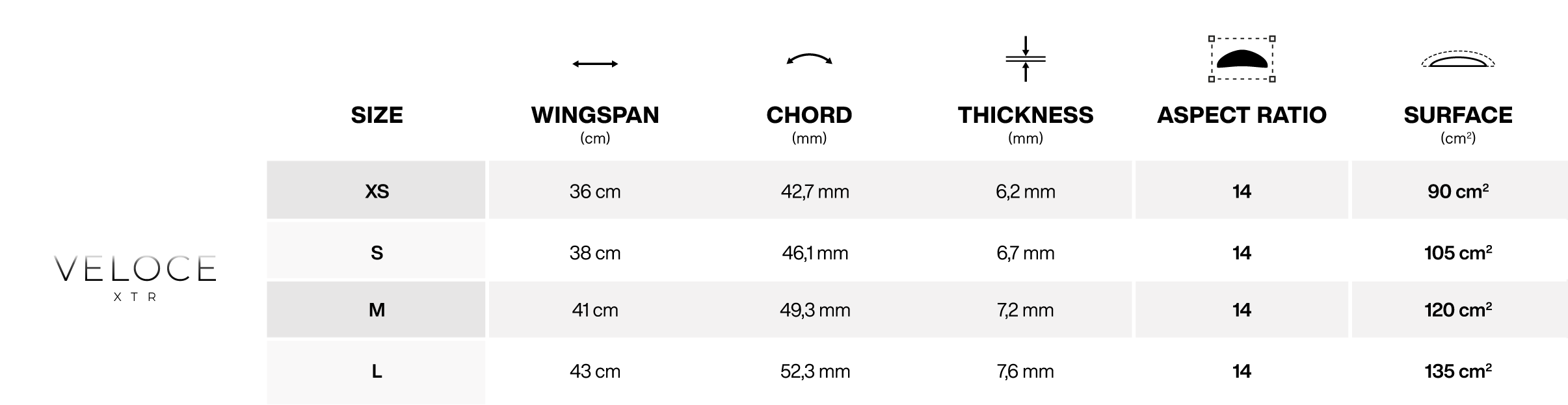
Its very high 14.0 aspect ratio reduces induced drag to an absolute minimum. The foil accelerates instantly on the slope, overtakes bumps and keeps enough speed to cross less supportive sections without repeated speed build-ups.
Its balance is deliberately tuned to generate very little front foot lift. The foil drops freely down the bumps without excessively lifting the board’s nose, never slowing down, which reduces strain on the front leg and keeps handling smooth on long runs.
Its thicker, more powerful and relatively neutral profile keeps the support needed to control take-offs, transitions and pitch changes. Hardly affected by saturation, it stays perfectly locked in as the foil accelerates, letting the Front Wing develop its full speed.
Its extremely stretched outline stabilises lines at high speed and frees up yaw. The area retained through the centre maintains precise support at the core to control pitch and commit to line changes despite the extreme thinness of the tips.
Its Lower architecture positions the Tail Wing farther from the surface and frees up its upper surface. The tips have more margin before breaching, ventilation happens later and the behaviour stays cleaner through acceleration.
Built in CNC-machined monolithic T700 carbon, it holds its profile and angle of attack with extreme precision under heavy loads. This maximum stiffness is essential to unlock the efficiency of a 14.0 ratio Tail Wing.
The reference setup with a Long Tail Shaft and 0° Tail Shim maximises drive, longitudinal stability and long lines.
Paired with the Veloce XTR Front Wing, it creates our fastest and most efficient downwind race foil setup.
In wing foiling and lowkite, this combo delivers another way to fly: little power underfoot, but lift generated constantly by exceptional glide. The foil keeps moving forward and flows through transitions with incredible smoothness. The ultimate glide.
The Tail Wing Veloce XTR V3 Atmo Pro Team Series is aimed at expert riders looking for maximum performance in downwind performance and downwind racing.
It is developed for those who already know how to precisely manage attitude, flight height and speed variations. Its 14.0 ratio greatly reduces drag, but offers less presence and headroom at low speeds than a Veloce DW.
It is suitable for competitors who want to overcome bumps, maintain a very high average speed and save energy over the duration of a run.
She also speaks to wingfoilers and expert lowkiters who want to discover a plane very different from the usual powerful combos: little pressure underfoot, but a glide that continually generates lift.
The Veloce XTR is above all designed for downwind racing. It allows you to accelerate very hard on each slope, to overcome the bumps which stifle the trajectory and to maintain enough speed to reach the next ones. It's like running downhill.
Its minimal drag reduces the number and intensity of restarts required. The rider uses more speed and energy from the body of water and spends less energy maintaining the flight.
Its low nose up effect lets the board follow slopes naturally. The front leg works less to contain the plane and the piloting remains more fluid on long descents.
In wingfoil and lowkite, it produces a particularly soft and sliding feeling. Associated with a Front Wing Veloce XTR, it gives little power under the feet at low speed, but the glide quickly generates the lift necessary for flight. Once launched, the association moves forward continuously, maintains high speed in soft terrain and offers exceptional glide in transitions.
It can also be used for pure pumping on the flat by an expert rider. Its output is very high, but this program remains marginal and requires a precise cadence as well as excellent height management.
The Veloce XTR is not a Tail Wing of progress. It requires excellent control of the aircraft and offers less margin in departures, slow phases and attitude errors.
To build the foundations of pumping, choose a Trail. For more dynamic and playful pumping, a Hyper Trail will be more suitable. For long distances on the flat, choose a Supra Trail or an Ultra Trail depending on your level.
For high-performance downwinders with more downforce, versatility and control at low speeds, the Veloce DW is a more accessible solution.
For committed surf foiling, snaps, tight curves and landings, choose a Tail Wing Ypra Surf Carve or a more surf-oriented model.
If you're looking for a lot of power underfoot in wingfoiling or lowkiting, the Veloce XTR won't match that feeling. It works by speed and glide, not by massive support.
The choice of size depends on the Front Wing, the weight of the rider, the desired speed and the desired level of control.
A large Veloce XTR maintains more support in starts, transitions and speed variations. It stabilizes the trim and facilitates control, but generates slightly more drag.
A small size further reduces drag, frees up speed and reduces pressure in the front foot. On the other hand, it requires extremely precise management of the attitude and becomes more demanding when the plane slows down.
The best choice is not always the smallest size. A Tail Wing too small can force the rider to make multiple corrections, lose height and waste more energy than what is gained in drag reduction.
In racing, choose the smallest size that you can control cleanly over the entire course, not just in the fastest stages.
In this configuration, the tail wing is in Lower mount.
It works with a Tail Shaft Lower associated with a Shim Tail Lower. It cannot be mounted on a Tail Shaft Upper or a Shim Tail Upper.
The reference assembly uses a Tail Shaft Medium and a Shim Tail Lower 0°. It offers the best balance between stability, ease, cadence and performance to discover the Tail Wing and understand their behavior.
The Lower assembly places the Tail Wing farther from the surface when the plane is flying high.
This position provides more margin before a tip comes out of the water. It delays ventilation and secures acceleration when the foil is driven very close to the surface.
The upper surface also remains better supplied and less exposed to turbulence coming from the Front. Wing and rear system.
At very high speed, this flow quality limits saturation, maintains a more constant response and reduces the feeling of resistance at the rear.
The Shim Tail 0° maintains the reference incidence calculated for the Veloce XTR.
It does not mean that the Tail Wing is horizontal in relation to the fuselage. The incidence necessary for the operation of the model is directly integrated into its carbon seat.
The Shim Tail number only indicates the angle added or removed from this reference.
0° is therefore always the best starting point to understand the balance of the aircraft before modifying the front foot or its longitudinal behavior.
Start with a Shim Tail Lower 0°, which is the Veloce XTR's reference setting.
A negative angle number increases the nose up effect of the Tail Wing. It adds front foot and more presence in starts or slow phases, but also increases drag and limits part of the desired performance.
The -0.5° can correct a combo that slightly lacks front foot or low speed support. Higher values deviate significantly from the natural program of the XTR.
The +1° further reduces the pressure in the front foot and releases the plane at high speed. However, it requires more control from the back foot and makes starts, transitions and slowdowns much more technical.
In racing, the fastest setting is not always the one that produces the least front foot. You must maintain enough downforce to control the plane and use its full speed without permanent corrections.
The Front Wing Veloce XTR is the reference association. This combo forms the fastest and most efficient downwind race plane in the range.
The Tail Wing Veloce XTR can also be combined with a Veloce DW to maximize speed and stability at high speeds, with less downforce in slow phases than a Tail Wing Veloce DW.
With a Veloce FF or a Veloce LW, it greatly frees up wingfoil and lowkite gliding. This setup is suitable for expert riders who are looking for high average speed and a very smooth plane rather than high power underfoot.
His association with a Front Wing Ultra Trail is technically possible for pure pumping. It then offers extreme performance, but requires very precise piloting and remains marginal compared to Tail Wings specifically developed for pumping.
Associated with the Front Wing Veloce XTR, the Tail Wing Veloce XTR results in an aircraft with very little power underfoot at low speeds.
You should not try to pilot it like a foil that rises thanks to strong pressure under the front foot. You have to let it accelerate. Speed gradually generates lift and the plane begins to fly with very little resistance.
This feeling is extremely soft and pleasant. The foil constantly advances, retains its energy in the soft areas and offers exceptional glide when traction disappears in transitions or freefly.
The Front Wing Veloce XTR is natively set back 2 cm. For use in wingfoil or lowkite, move your mast forward about 2 cm from your usual position, then fine-tune this adjustment according to your board, your stance and the desired pressure.
Start with the reference combo, a Long Tail Shaft and a 0° Shim Tail.
Use this setup long enough to understand the low front foot, high speed stability, and how the airplane behaves in departures and transitions.
Then only modify one element at a time. A size variation of Tail Wing, Tail Shaft length, Shim Tail or mast position can profoundly change the overall balance.
Look for an airplane that accelerates freely while remaining controllable as speed decreases. Minimal drag does nothing if it requires permanent corrections or prevents you from maintaining a clean trajectory.
In downwind racing, the best setting is the one that allows you to stay high, overcome bumps and maintain your speed until the finish with the minimum of unwanted movements.
In this configuration, the tail wing is in Lower mount.
It works with:
The V3 and Micro V3 Atmo Tail Shafts are not interchangeable on the fuselage side.
The Shims Tails can be mounted either on Tails Shafts V3 or Micro V3.
The Tail Wing remains compatible with both diameters thanks to its standard footprint. You must use the Tail Shaft corresponding to the diameter of the fuselage.
It cannot be mounted on a Tail Shaft Upper, a Shim Tail Upper.
Each pack comes with all the screws needed for assembly.
Tail Shaft:
Shim Tail