Your cart is empty!
It's flat around here...


The hybrid carbon front wing, part pumping part wind sports, for dockstart, flat start, SUP foiling and surf foiling in small waves, accessible downwind, wing foiling light wind and lowkite light wind.
The Sirus V3 Atmo Team Series is the high aspect carbon front wing that maximises lift, pumping and glide in low energy conditions. Its role is clear: take off very early, stay in flight with minimal effort and turn every impulse and gust into flight distance.
It's a hybrid front wing: part pumping, part wind sports. It allows you to dockstart, pump for a long time, attempt flat starts, take off on almost nothing, but also fly in wing foiling or lowkite with very little wind with a foil that remains precise and manageable.
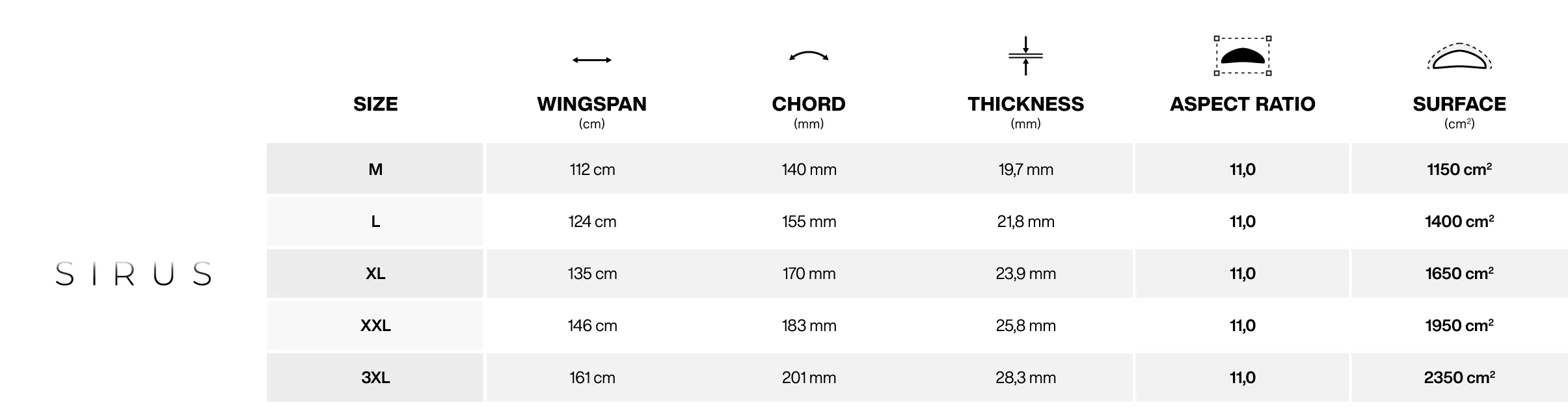
With its 11.0 aspect ratio consistent across all sizes, the Sirus retains the same DNA throughout the range: massive lift, significant glide, highly efficient pumping and controlled manoeuvrability. The smaller sizes remain relatively manoeuvrable for lighter riders or multisport use. The larger sizes maximise ease in dockstart, flat start and very early take-offs in 6 knots or less.
The Sirus Team sits between a Trail Team and a Veloce LW. The Trail is simpler but slower and ideal for learning pumping. The Veloce LW offers more speed and Veloce-style glide. The Sirus Team provides more lift, more lift in slow phases and more low-speed ease, while remaining much faster and more precise than a 100% pumping wing.
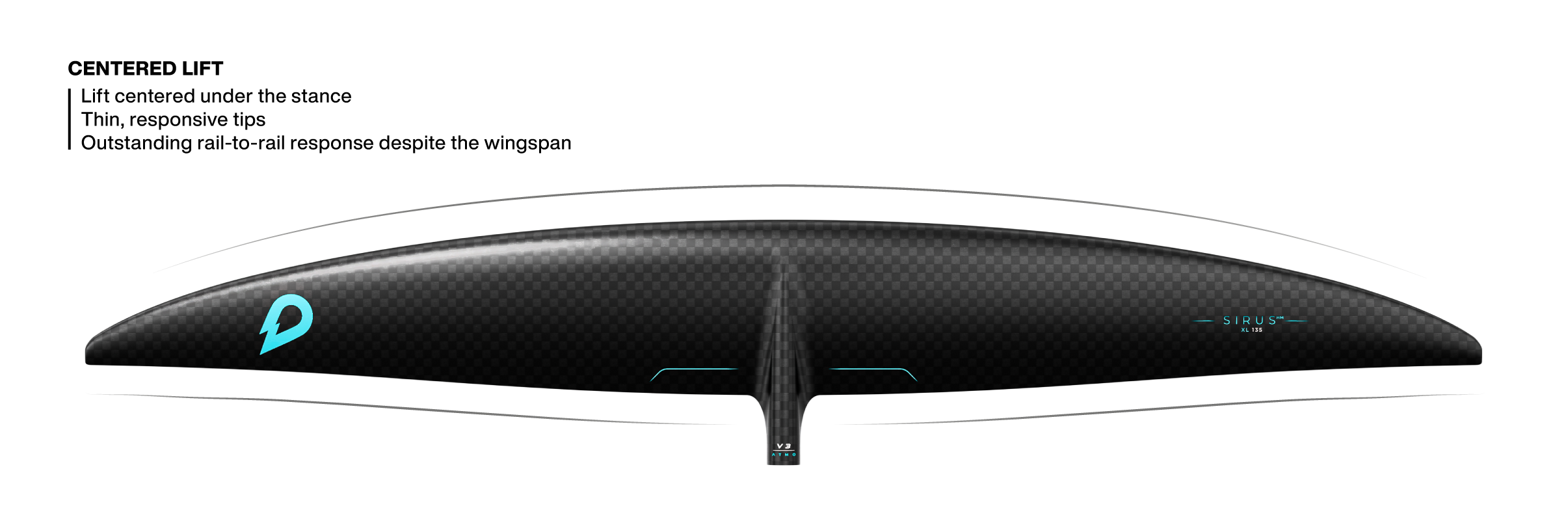
Its specific outline concentrates lift around the supports. The rounded leading edge, inverted omega trailing edge, highly supportive core and fine tips give a wing that provides strong lift without becoming unmanageable in rail to rail. It's fun to pilot.
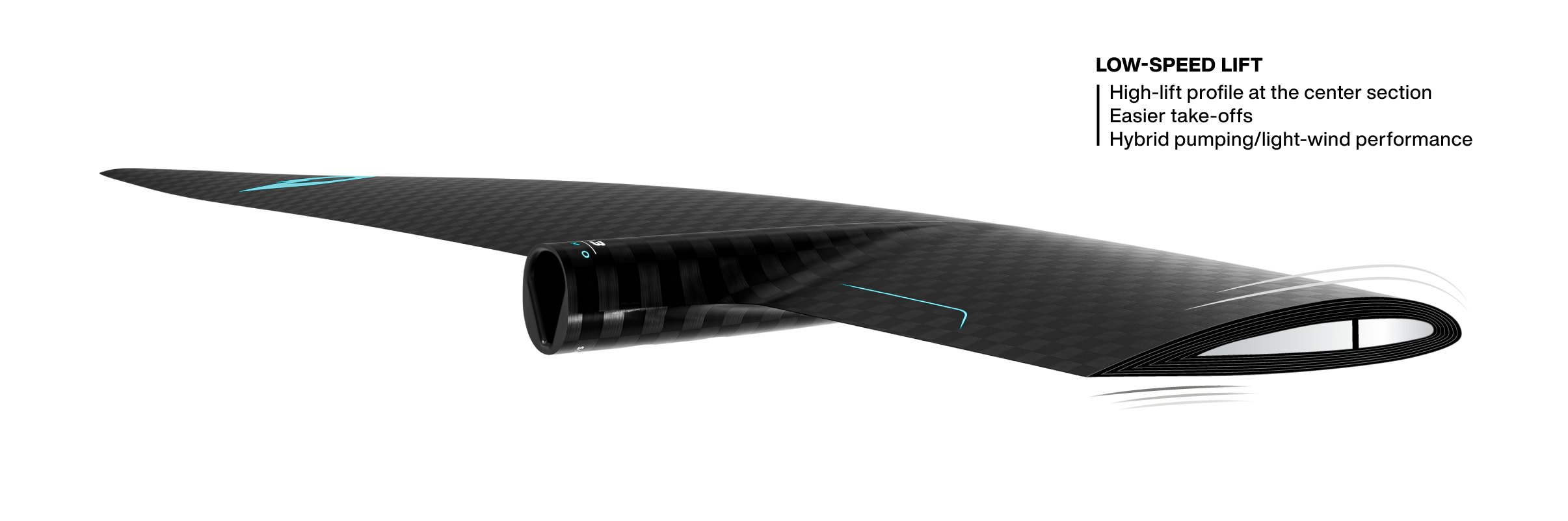
The very thick profile on the central two-thirds provides a lot of lift at low speed. The wing loads early, lifts the board and gives time to establish rhythm, in pumping as in sup foiling, wing foiling light wind or lowkite.
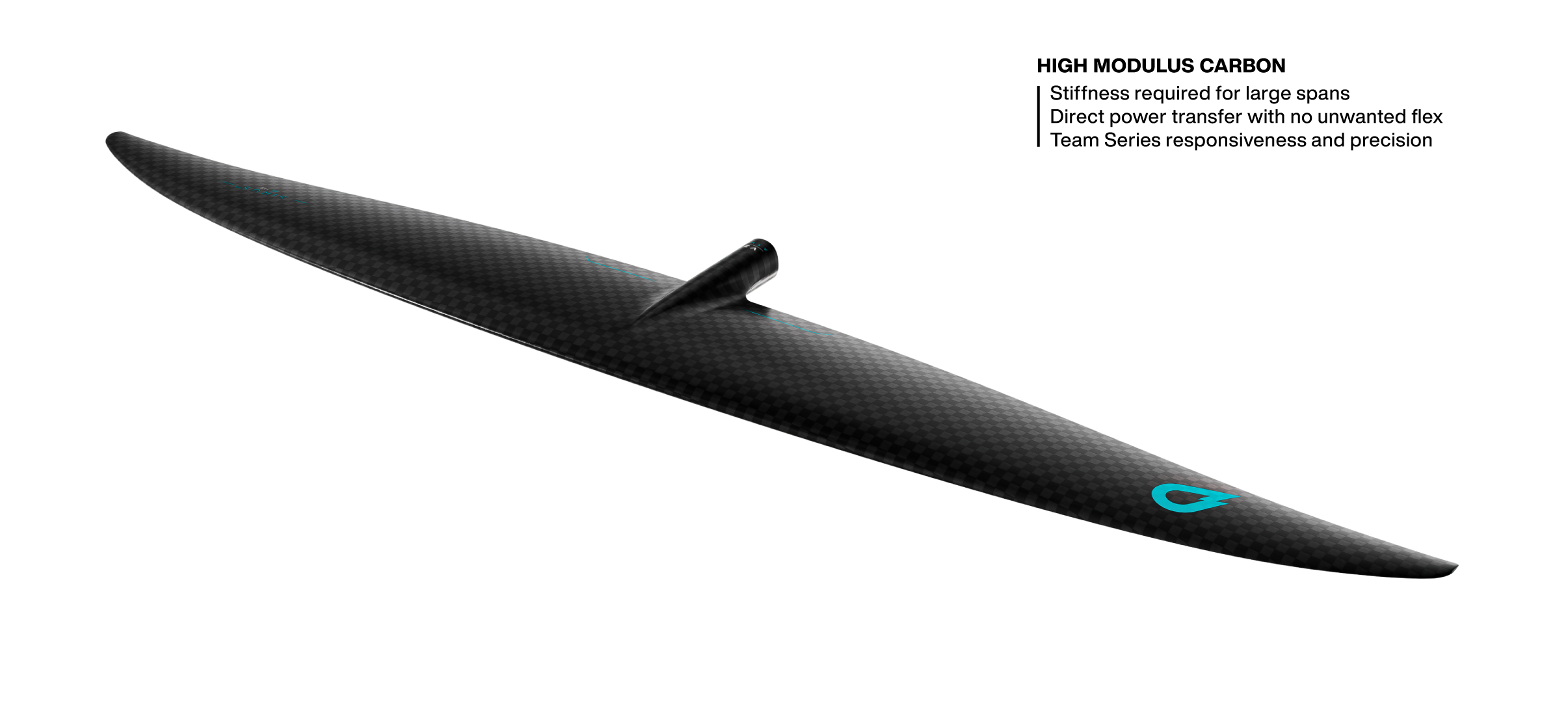
The Team Series carbon construction is essential on such a wide wing. It locks in flex and torsion, transmits pressure directly and keeps a precise, dynamic and readable foil underfoot.
The Sirus V3 Atmo Team Series is the wing for flying very early, pumping far, taking off in almost nothing, exploiting small waves, light wind and low energy sessions with the rigidity, look and precision of a Team Series carbon construction.

The Sirus V3 Atmo Team Series features a constant aspect ratio of 11.0 across all sizes. This choice provides a consistent DNA throughout the range: massive lift, glide, efficient pumping, acceleration in wind sports, and control.
This ratio places the Sirus in the high aspect ratio category, with a true focus on glide and efficiency, without becoming a super high aspect wing that is too locked for its intended use. The goal is to provide early lift, effortless pumping, flight in minimal conditions, and maintain manageability.
Each size retains the same identity but changes in power. Smaller sizes gain in top speed, maneuverability, and multisport versatility. Larger sizes maximize dockstart, flat start, long-distance pumping, and very early take-offs.
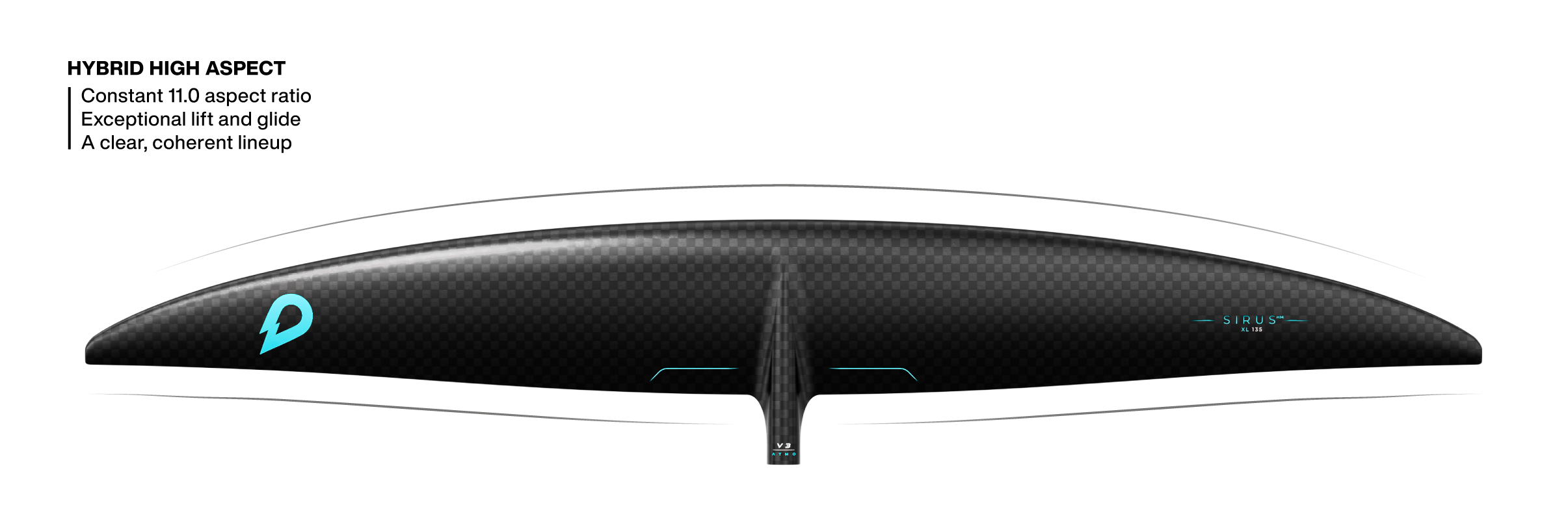
The outline of the Sirus concentrates lift around the supports. The rounded leading edge and the inverted omega trailing edge allow for a highly lifting core without unnecessarily spreading the surface towards the tips.
This distribution is essential on a large front wing. If the lift is too spread across the entire span, the wing becomes heavy in yaw, difficult to reposition, and cumbersome in corrections. The Sirus maintains a powerful center and freer tips.
Result: the rail to rail remains impressive for a wing of this size. The foil provides strong lift, yet remains docile, maneuverable, and much more enjoyable than its wingspan might suggest.
The profile of the Sirus is highly lift-oriented on the central two-thirds of the wing, with significant thickness relative to its chord. This is what provides the enormous lift at very low speeds.
This lift facilitates starts in dockstart, flat start, beach start, SUP foiling with a paddle, wing foiling in light wind, lowkite, and pumping. The wing engages early, lifts the board, and gives time to establish the rhythm.
This hybrid profile combines the qualities of dock start and light wind. It allows flying with very little energy, but without immediately maxing out in Vmax like a 100% pumping wing that is too slow.
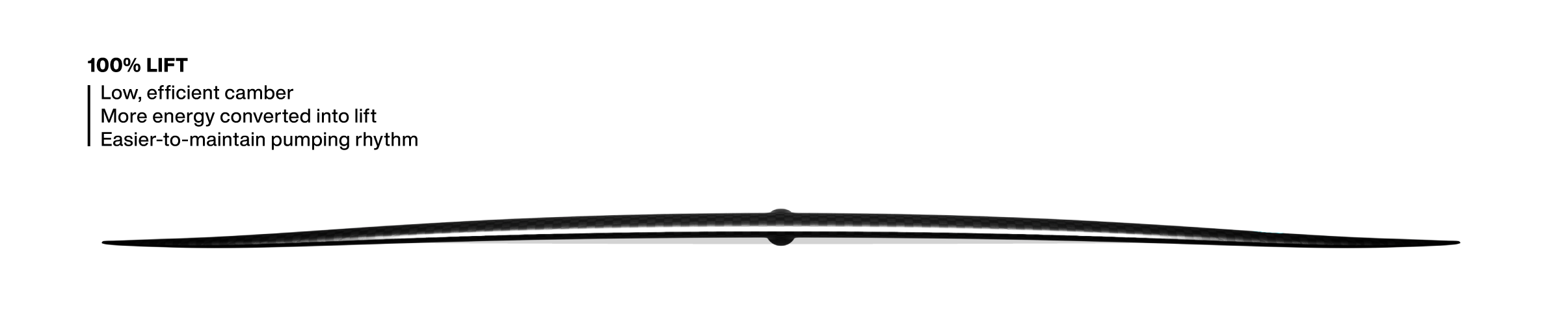
The anhedral curvature is low, slightly negative at the center, then almost horizontal towards the tips. This geometry results in a very efficient wing, offering 100% of its lift instead of wasting energy on unnecessary control within this usage range.
In pumping, this efficiency changes everything. The foil maintains its rhythm, provides strong lift, and requires less energy. The rider can focus their energy on pressure, trajectory, and relaunch.
In sluggish conditions, every watt counts. This almost flat curvature allows the wing to remain highly productive in lift while keeping the tips flat enough for shallow depths.
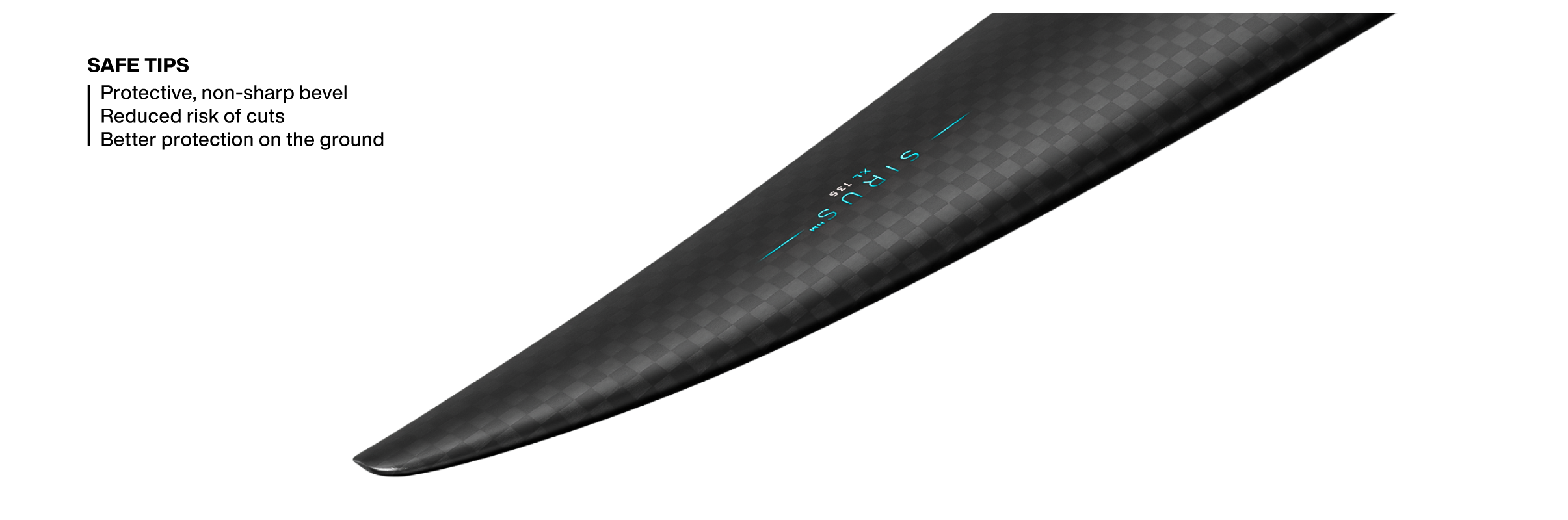
The protective tips with a large, non-sharpened facet are a true design choice on the Sirus. They limit the risk of severe cuts in case of a fall on the wing's tip.
They also protect the front wing in situations where the wing operates close to the ground, dock, sand, or bottom: dock start, beach start, flat start, shallow water starts, shore break passage, handling on land, and first attempts with a large wing.
The trailing edges remain thin to preserve hydrodynamic efficiency and should be handled with care. Thus, you gain in safety and durability without compromising the foil's efficiency.
The Team Series carbon construction is fundamental on a wing like the Sirus. As the wingspan increases, the bending and torsional forces become enormous. Without rigidity, a wide wing would lose precision, efficiency, and control.
The high modulus carbon, calculated layup, central stiffener, and carbon reinforcements lock the shape. The pressure is directly transferred into the wing, without any parasitic flex feeling. When pumping, each impulse is better transmitted.
The 12K clear carbon finish marks the Team Series level. It highlights a large, thin, technical wing that is costly to produce but essential for achieving this mix of lift, rigidity, dynamism, and precision.
The Sirus V3 Atmo Team Series is designed for riders who want to fly with very little energy, take off early, and maximize flight time in light conditions without switching to a soft, slow, or imprecise wing.
It primarily appeals to pumping enthusiasts who want an efficient wing for dockstart, flat start, beach start, or long-distance pumping. The larger sizes provide plenty of lift and time to establish rhythm. The smaller sizes are for lighter or more energetic riders who want to maintain more maneuverability.
In wing foiling and lowkite, it is made for those who want to fly in very light air, take off in 6 knots with the right setup, use small wings or minimalist lowkites, and maintain a wing that is even more supportive at low speeds than a Veloce LW.
In SUP foiling, it is for riders who want to feel the lift very early when paddling, take off well before the wave breaks, and exploit soft bumps, mushy waves, or small swells with a foil that provides a lot of flight time.
In surf foiling, it suits riders who want to glide in small waves, make long diagonals, carve smoothly, and reconnect easily. You need to adapt your style: no short snaps, but glide, rhythm, and long carving turns.
In downwind, it is ideal for those who want to make the program more accessible. It facilitates take-offs, provides leeway in flatter areas, and allows you to exploit soft or inconsistent bumps with a highly supportive foil.
The Sirus Team is not the best choice for completely starting out in classic foiling. For learning the first flights, stabilizing your stance, and progressing without stress, the X-Over or the Ascent are more suitable.
It is also not the fastest wing in the range. If the goal is maximum speed, fast freefly, long fast trajectories, or light wind with more speed, the Veloce LW would be more logical.
It is not designed for short snaps or radical riding in surf foiling. Its wingspan and lift require an adapted style: long carving turns, glide, rhythm, and easy reconnections. For more aggressive surf foiling, the Fluid would be much more suitable.
If the goal is simply to learn pumping with maximum ease and very low speed, the Trail might be simpler. The Sirus goes further in performance and versatility but requires managing a large wing.
If the goal is highly performant or very fast downwind, a dedicated Pro Team wing will go further. The Sirus Team makes downwind accessible, supportive, and reassuring, but it is not a pure speed wing.
The Sirus V3 Atmo Team Series is designed to maximize lift, pumping, and low-end range. It serves to fly very early, stay airborne with very little energy, and transform small impulses into distance.
In wing foiling and lowkite, it is made for very light winds. It takes off extremely early, maintains flight with little air, and provides plenty of leeway with small wings or minimalist lowkites. It is slower than a Veloce LW but more supportive and easier at low speeds.
In SUP foiling, it allows for very early take-offs when paddling, often well before the wave breaks, and to exploit mushy waves, small swells, or weak bumps. It offers a new perspective on spots usually unexplored in these conditions.
In surf foiling, it is made for small waves, mushy waves, wind waves, and sessions where you want to fly long rather than snap. It allows for gliding, making long diagonals, and easy reconnections.
In pumping as a standalone sport, it is made for dockstart, beach start, flat start, and long phases on the flat. The larger sizes facilitate take-offs and provide plenty of time to set the rhythm. The smaller sizes offer more maneuverability and speed.
In downwind, it facilitates take-offs, slow phases, and flatter areas. It helps exploit soft or inconsistent bumps with a wing that provides strong lift and time. It also stabilizes the board with its large volume that anchors the board. Very useful when starting downwind or on very narrow boards.
In flat start, the Sirus Team opens up a very specific program. With a suitable board, a good level, and a sufficient size, it allows for take-off on the flat with only human energy. It's demanding, but it's one of the most magical sensations in foiling.
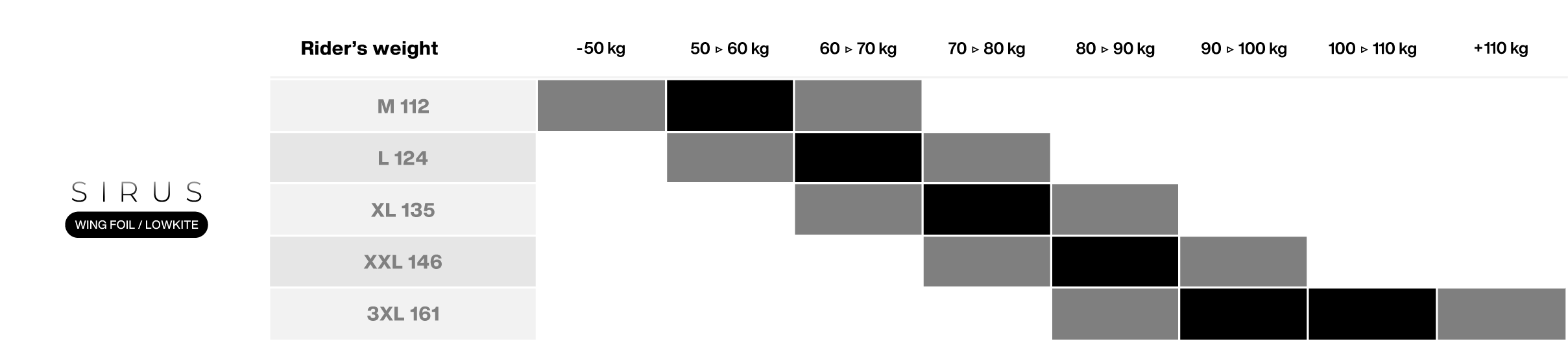
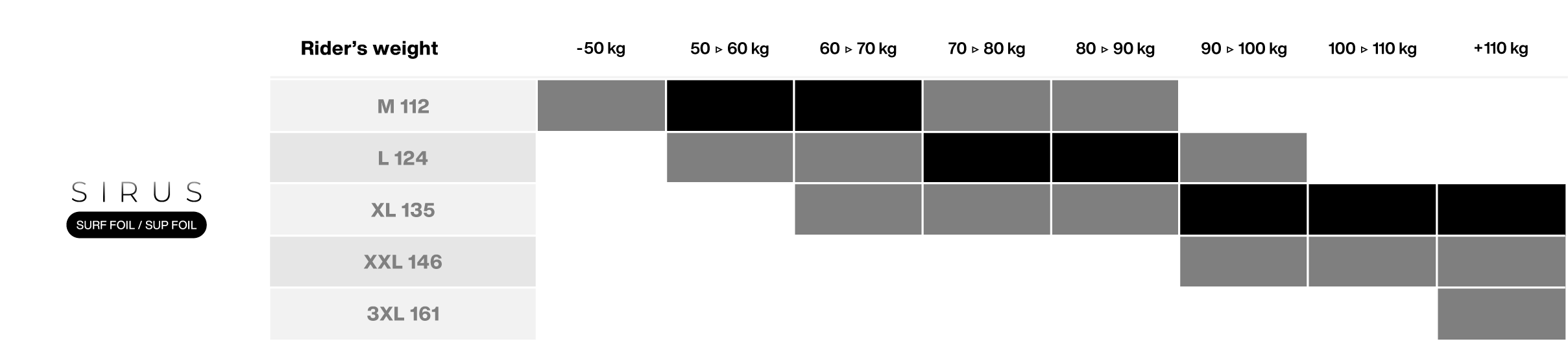
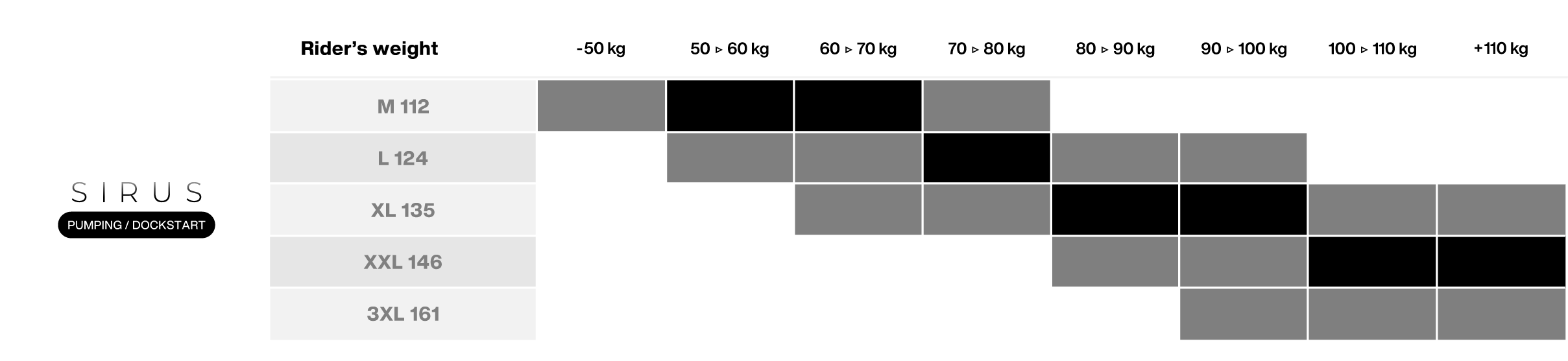
The choice of size depends on weight, level, support, type of start, and objective: dockstart, flat start, pumping, SUP foiling, surf foiling, downwind, wingfoil light wind, or lowkite light wind.
Choosing a smaller size allows for generating more speed, having more rail to rail, and more maneuverability. It is the logical choice for wingfoil light wind, lowkite light wind, and lighter riders, very energetic practitioners, or those who want to use the Sirus in small waves, in surf foiling, or in SUP foiling with more control.
Choosing an intermediate size provides the best multisport compromise: efficient pumping, SUP foiling in almost nothing, very cool surf foiling, wingfoil light wind, lowkite light wind, and accessible downwind. It is often the most versatile choice, especially for heavier riders or those with imperfect pumping in wing.
Choosing a larger size maximizes lift, dockstart, flat start, long-distance pumping, and take-offs in almost nothing. It is the choice for larger builds, practitioners who want to learn or push flat start, or very soft sessions.
In wing foiling and lowkite, the larger sizes are too extreme, but the medium sizes are ideal for very light winds, heavy builds, or small wings (4.5m2 for example) / minimalist lowkites. Smaller sizes allow for more speed and comfort as soon as the wind picks up and fly from 6 knots with effective pumping.
In surf foiling / SUP foiling, small sizes are sufficient to take off early and reconnect easily, but not too large if the goal is to maintain clean carving turns. The right size depends on the build, spot, and desired style. Medium sizes are huge in this program and reduce the possibility of making carving turns.
In pumping / dockstart / flat start, generally more surface is sought to facilitate take-off and prolong flight. The most technical riders can reduce to gain speed, rail to rail, and dynamism.
In downwind, medium sizes facilitate take-offs and flatter areas but will quickly saturate and be too large. Smaller sizes are more suitable.
If hesitating between two sizes, choose the larger one for ease, dockstart, flat start, early SUP foiling, and light wind. Choose the smaller one only if the level, build, and conditions justify more speed and maneuverability.
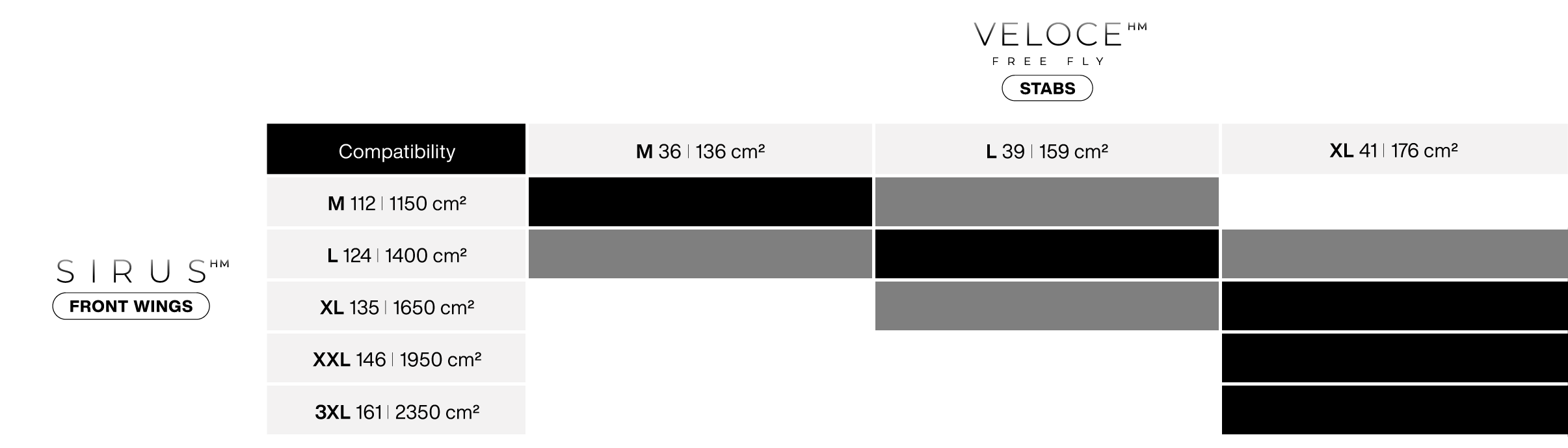
The Sirus V3 Atmo Team Series does not have a dedicated stabilizer. The choice of stabilizer strongly depends on the program: pure pumping, dockstart, flat start, SUP foiling, surf foiling, wingfoil light wind, lowkite, or downwind.
The Veloce FF V3 Atmo Team Series stabilizer is the most coherent choice to maintain a good balance between glide, stability, pumping, and versatility. It provides a healthy, readable, and efficient foil to exploit the Sirus in most uses.
A larger stabilizer provides more stability, more front foot pressure, and easier take-offs. It is the logical choice for larger sizes, progressing practitioners, dockstart, early SUP foiling, or very light winds.
A smaller or higher ratio stabilizer frees the foil. It reduces drag, increases speed, and provides freer pumping but requires more precision in stance and foil adjustment.
For practitioners seeking even more performance, speed, and free glide, the Tail Wing Hyper Trail is the most performant alternative. It further frees the foil but makes the whole setup more technical.
The right setup depends on the front wing/stabilizer pair, but also on the foil's position in the boxes and the type of start. If the stabilizer is smaller and front foot pressure decreases, you will often need to slightly move the foil forward to regain a natural balance.
In summary: choose the Veloce FF stabilizer for comfort, stability, and versatility; choose a smaller stabilizer or a Hyper Trail to maximize performance, speed, and dynamic pumping.
The range

The front wing comes with all the necessary screws for mounting on the fuselage.












No, it's a hybrid wing: part pumping, part wind sports. It's excellent for dock start, flat start and pumping, in sup foiling, surf foiling in small waves, accessible downwind, but also works very well in wing foiling light wind and lowkite light wind.
The Trail is simpler, slower, and very suitable for learning pumping. The Sirus offers more glide, goes further, allows flat starts without stalling, and remains faster and multisport. Trail = easy pumping. Sirus = massive lift and hybrid program.
The Veloce LW goes faster and maintains a more Veloce feel, with more light wind-oriented glide. The Sirus provides more lift at low speeds, making it easier for take-offs, dockstarts, flat starts, and slow phases. Sirus = extreme lift. Veloce LW = speed and light wind glider.
Yes, especially in light wind. It takes off super early, maintains flight in light winds, and provides a lot of leeway with small wings or minimalist lowkites. It's slower than a Veloce LW, but more buoyant and easier at low speeds.
Yes, with a suitable board, a good skill level, and sufficient size. The Sirus is one of the most suitable wings for flat start thanks to its massive lift, 11.0 aspect ratio, and high-lift profile. It's demanding but absolutely magical.
Yes, especially in small waves and sessions where you want to glide for a long time. You need to adapt your style: no snaps or big carves, but long diagonals, smooth curves, and easy reconnections.
Choose larger for easier dockstart, flat start, and pumping in general. For light wind with a wing, choose smaller, especially if you are light, energetic, or if you want more speed, more rail to rail, and more maneuverability.
The Veloce FF V3 Atmo Team Series stabilizer is the most consistent choice for keeping a foil healthy, stable, and versatile. A smaller or higher aspect ratio stabilizer releases speed and dynamic pumping. The Hyper Trail Tail Wing maximizes performance but requires more precision and is not recommended for wing foiling.