Your cart is empty!
It's flat around here...
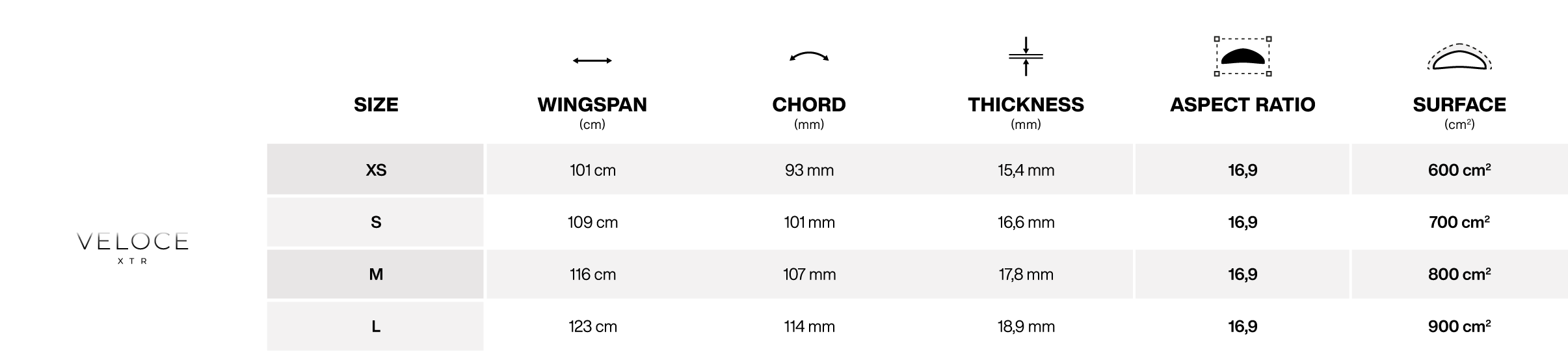
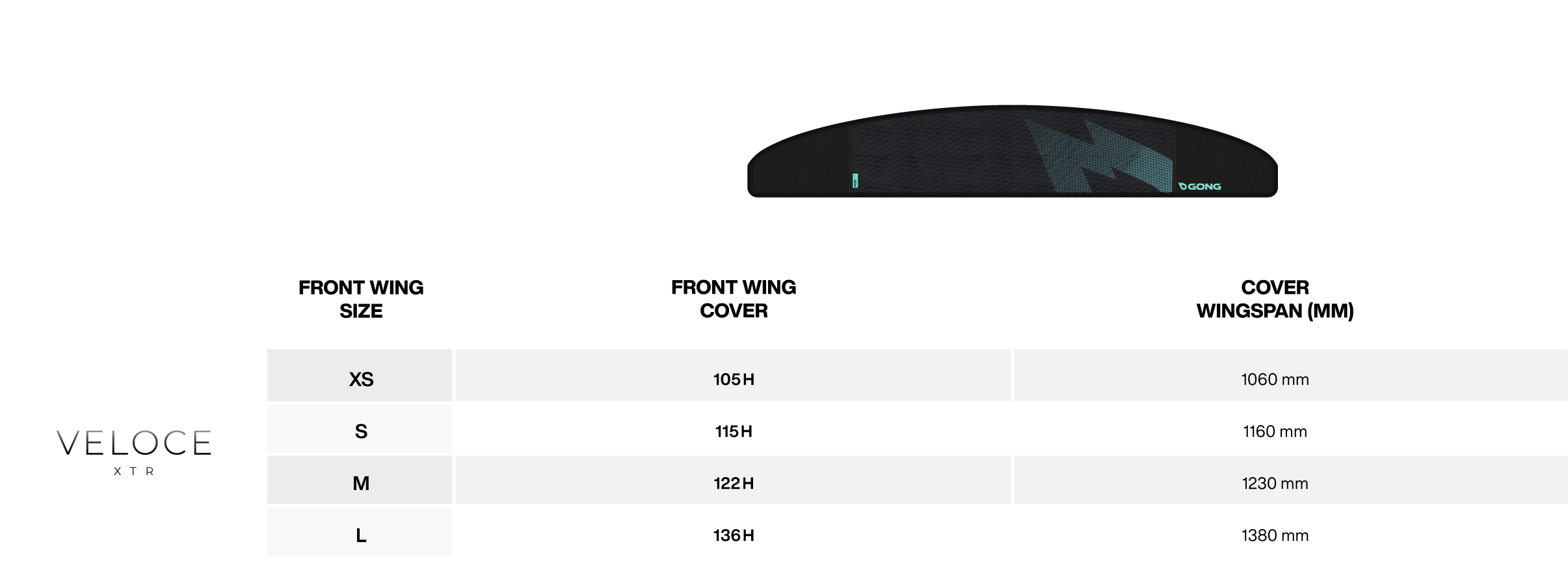


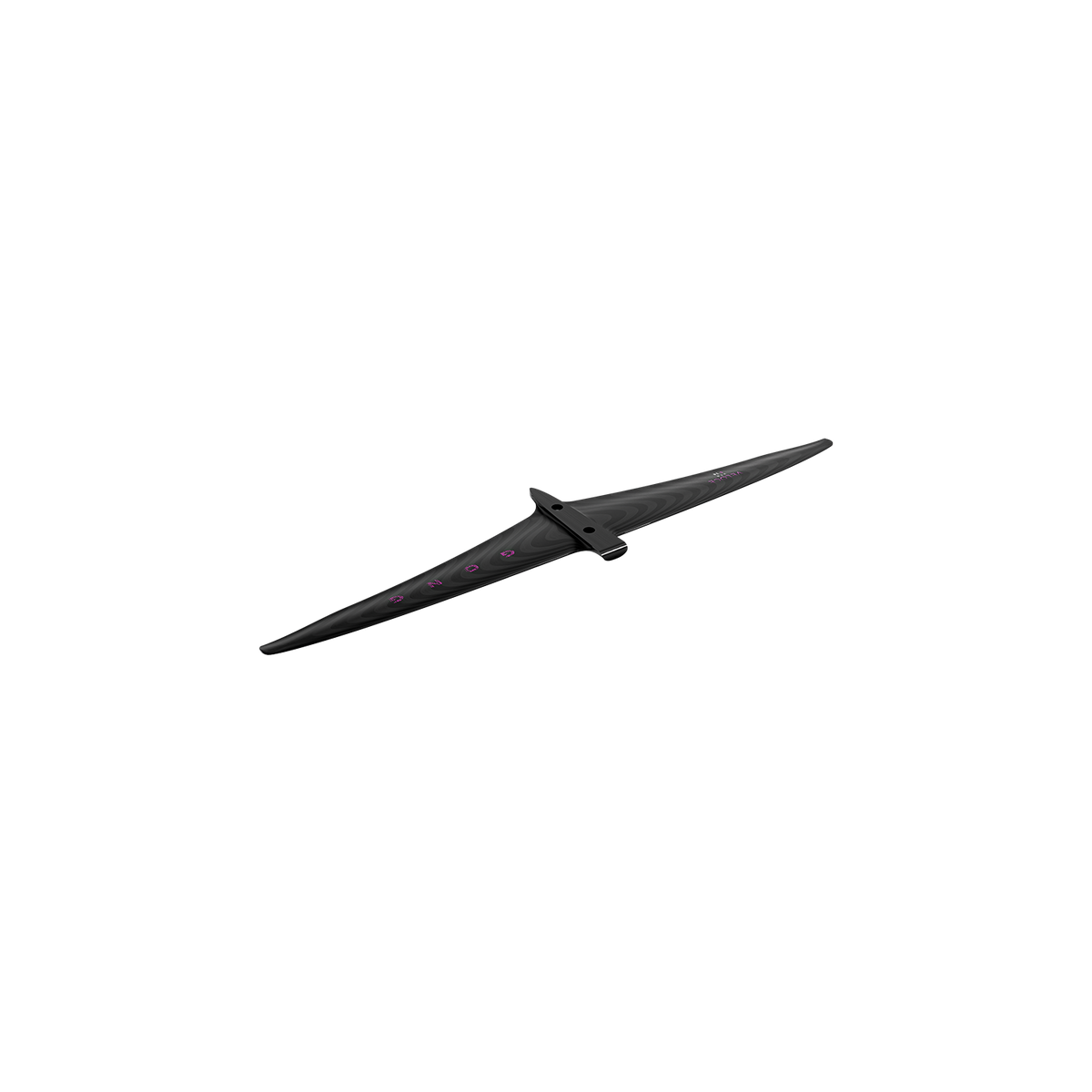
The carbon front wing with an extreme ratio for downwind racing, committed runs, records, tight trajectories, and experts who want to fly through the bumps.
The Veloce XTR V3 Atmo Pro Team Series is the carbon front wing with an extreme ratio dedicated to downwind racing, highly committed runs, records, and experts who want to race very fast using only the energy of the swell and bumps.
This is the ultra-charged version of the Veloce DW. While the DW remains more accessible, maneuverable, and forgiving, the XTR pushes everything towards pure performance: more ratio, more speed, more glide, more inertia, and much tighter trajectories.
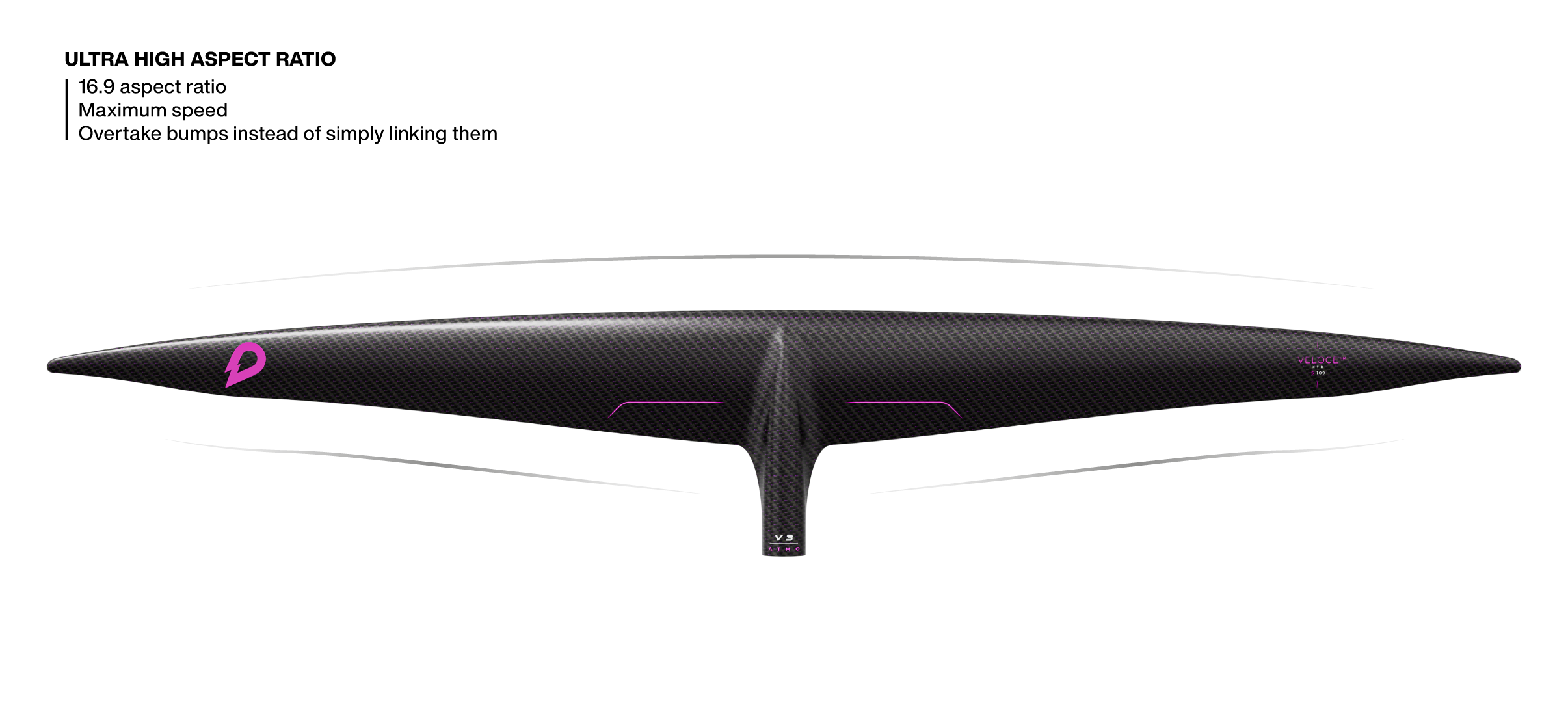
Its aspect ratio of 16.9 places it in the ultra-high ratio category. This ratio significantly reduces drag, maximizes hydrodynamic efficiency, and allows maintaining a very high average speed over long trajectories. The XTR is not just for following and connecting bumps: it allows you to enter the bump in front in a flash, surpass it, and reach the next one. You're constantly looking ahead and speeding through!!!
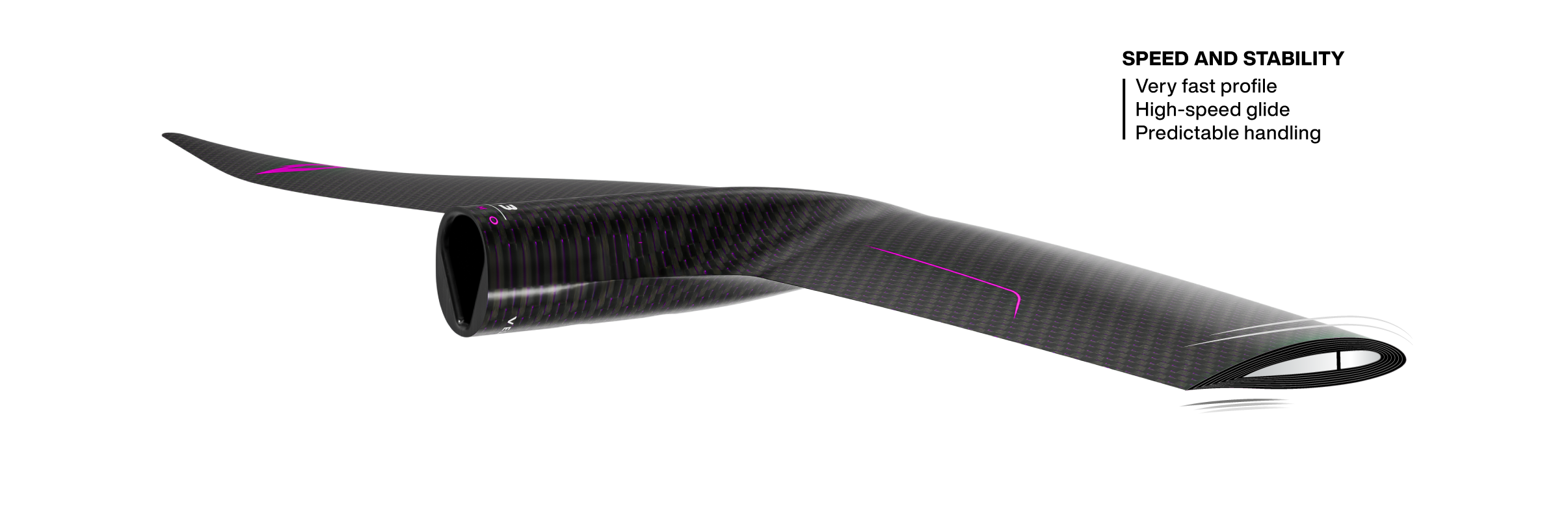
The high-efficiency profile is specialized for downwind, offering speed, glide, and stability during acceleration. This unique profile in the range targets speed without the traction of a rig.
The centered surface keeps the lift close to the supports despite the extreme elongation. The rider maintains a direct connection with the foil, more stability underfoot, and a better reading of micro-supports at high speed.
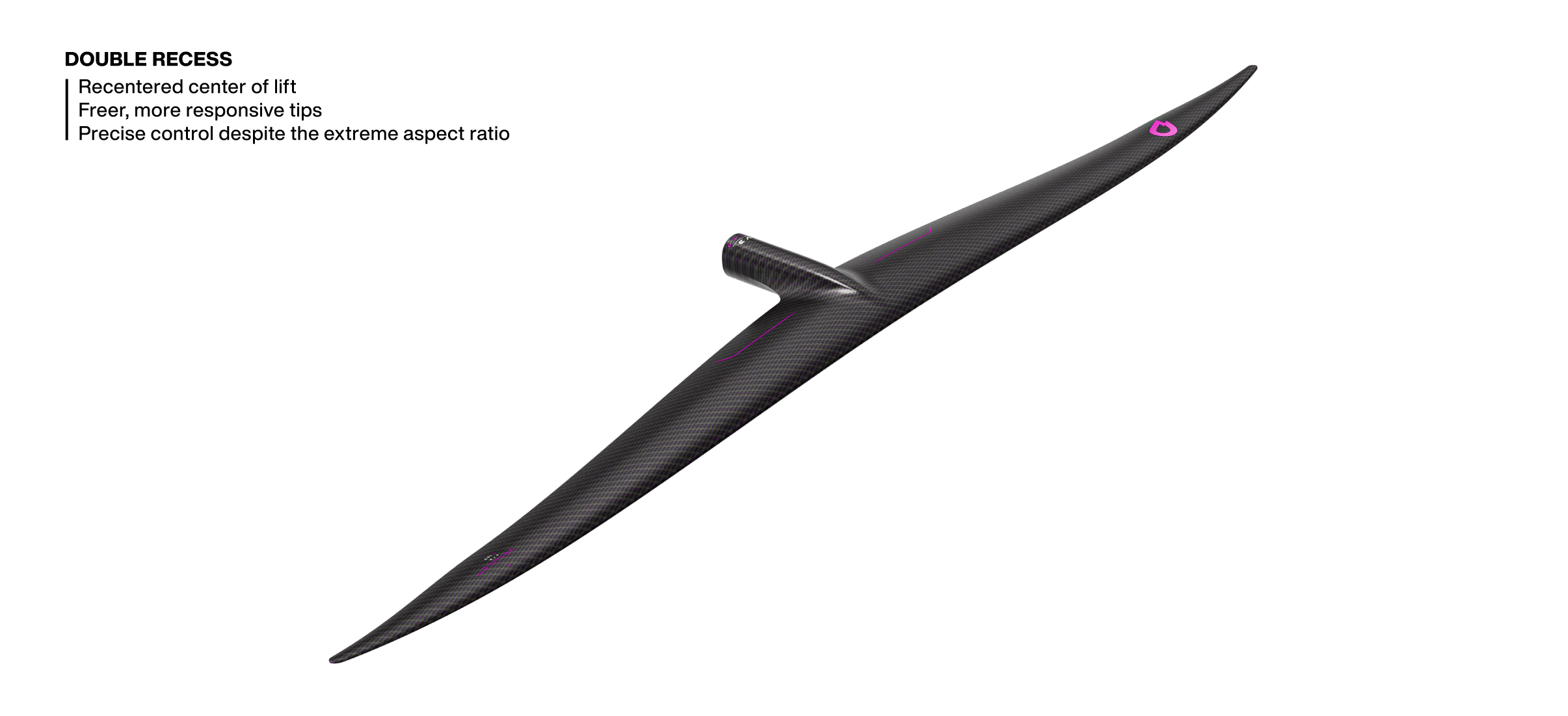
Its specific S-shaped trailing edge creates a double chord recess across the span. This design recenters the thrust at the heart of the front wing and frees the tips, maintaining control and exploitable trajectories despite such a radical ratio.
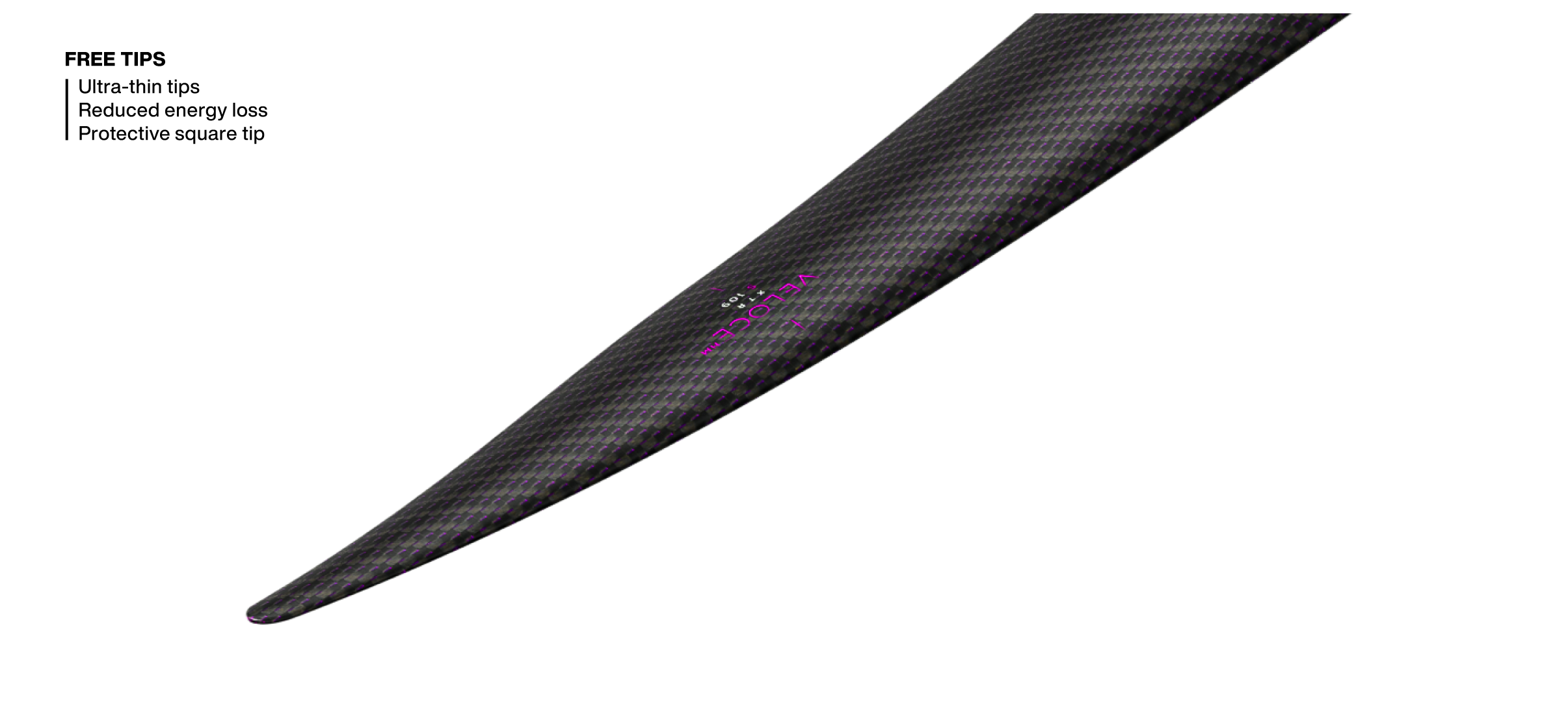
The ultra-thin, yet square and protective tips reduce drag at the wingtip, free the ends, and help maintain pleasant maneuverability for a wing with a 16.9 ratio.
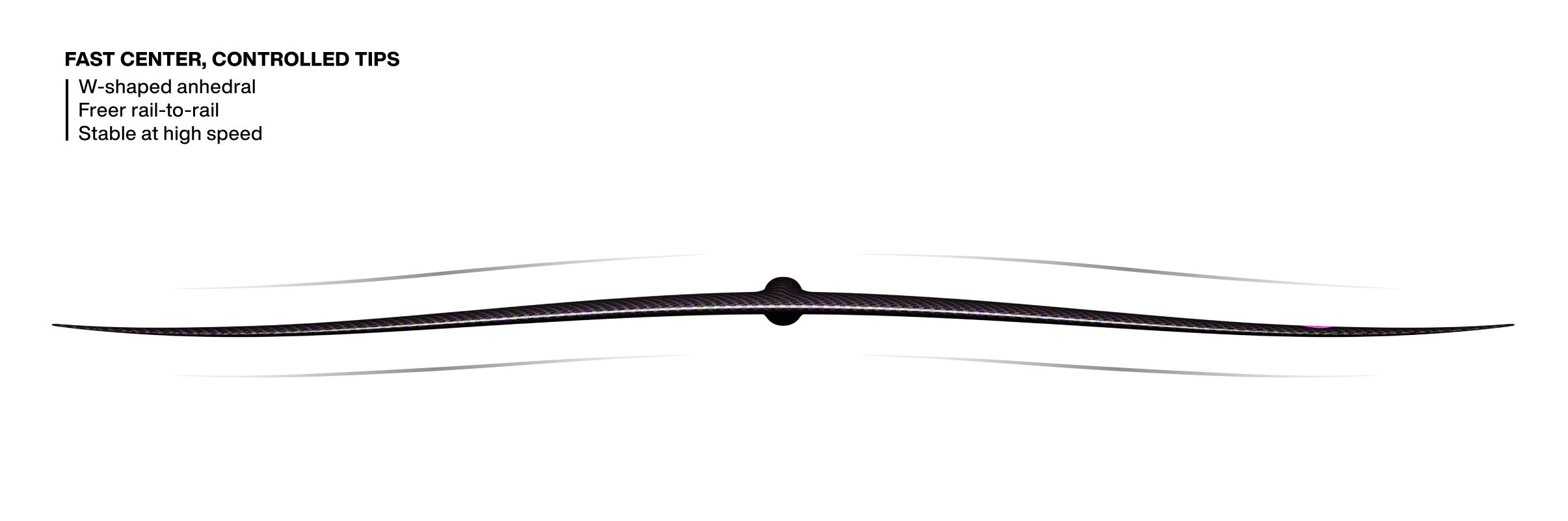
The W dihedral maintains a very stable center, offering a solid control base while working the ends with raised tips over a long portion but without excess to gain control and maneuverability.
The Veloce XTR is not a light wind, freeride, or carving wing. It is made to race, maintain speed without a rig, surpass bumps, and perform on committed runs. A highly specialized front wing, pushing the limits of high-performance downwind.

The Veloce XTR adopts an extreme ratio of 16.9 to significantly reduce drag and maximise performance in downwind racing. This is the core of its program: maintaining a very high average speed over long reaches.
This ratio allows for maintaining inertia, crossing flatter areas with glide, and reaching the next bump without forced pumping. The XTR doesn't just connect bumps: it surpasses them.
This level of elongation requires commitment and a true reading of the water surface. The reward is an extraordinary run speed for riders capable of exploiting it.
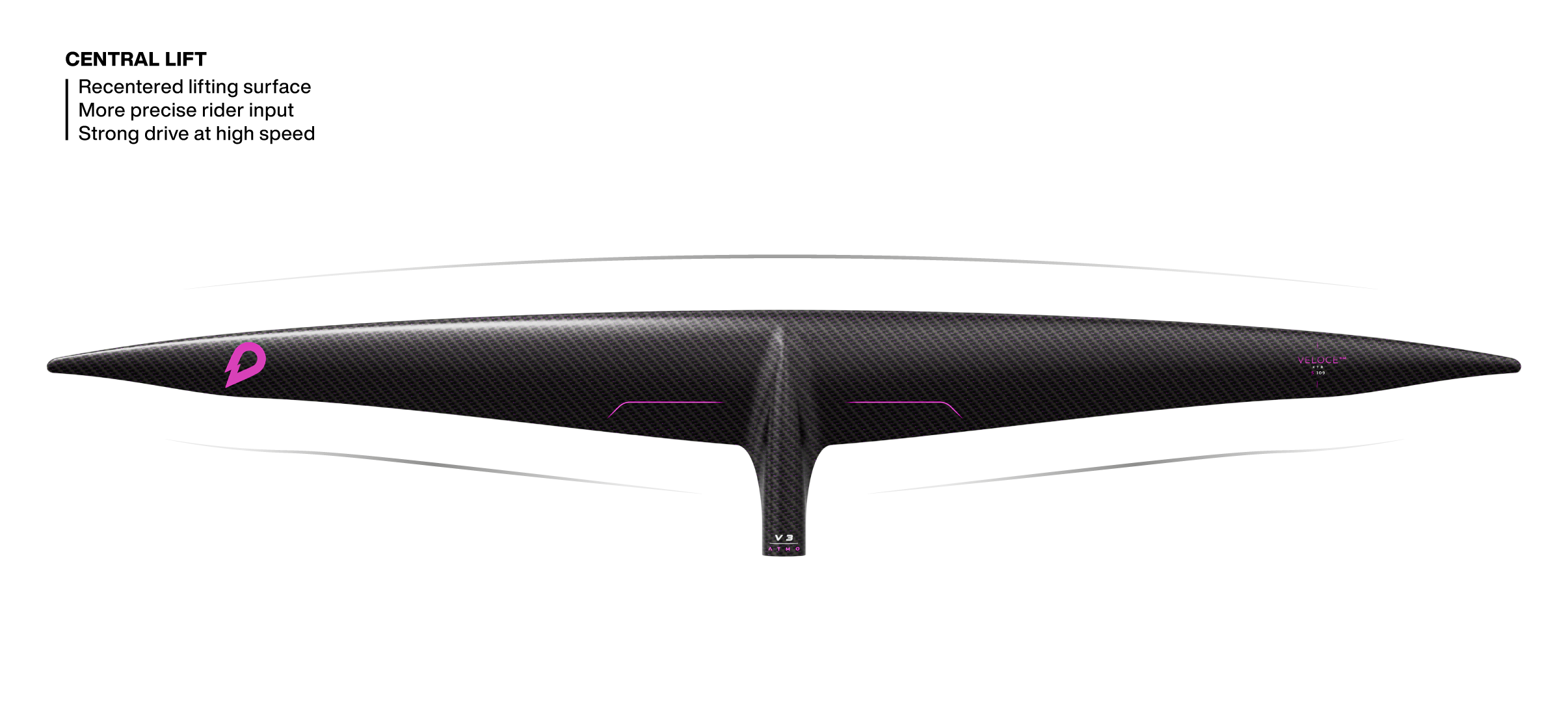
The centred surface keeps the lift close to the supports despite the extreme wingspan. On a wing of this size, it's essential to maintain a direct and manageable connection between the rider and the foil.
This placement provides more stability underfoot, better reading of micro-supports, and a clearer ability to reposition the wing during line or speed changes.
The XTR remains very focused in its programme, but this centred lift prevents experiencing a wing whose energy would be too far from the supports. You maintain drive and precision at high speed.
The specific S-shaped trailing edge creates a double chord recess along the span. This design centers the thrust at the heart of the front wing and frees the tips.
On a wing with a 16.9 ratio, this point is crucial. Overly prominent tips would lock the rail to rail and make the wing very physical, even tricky, during line changes.
The double recess allows maintaining the efficiency of an extreme ratio while keeping controllable trajectories. It's one of the keys to the XTR balance: very fast, very taut, yet still manageable by skilled riders.
The tips of the Veloce XTR are significantly tapered. The marked reduction in chord at the ends reduces wingtip losses and frees up the behaviour despite the very high aspect ratio.
They remain square and protective, with an end more reassuring than an ultra-pointed tip during handling, take-offs, and potential contacts.
This design helps maintain surprising manoeuvrability for such a fast wing. The XTR is not made for tight carving, but its freed tips allow for corrections, repositioning, and maintaining controllable trajectories.
The Veloce XTR profile is specialized for speed, glide, and high-speed stability. It offers ultimate glide and predictable behavior in challenging conditions.
It allows you to push hard without feeling like you're constantly on a tightrope, provided you have the skill level. The XTR remains stable for its program, but it requires commitment and precision.
This profile maintains its efficiency in slope changes, crossed bumps, quick transitions, accelerations in flatter areas, and high-speed trajectory corrections.
The W anhedral maintains a very gliding and stable centre, while working the tips to gain control, stability, and manoeuvrability.
This geometry frees up the rail to rail without sacrificing performance. On a wing with an extreme ratio, it's essential to avoid a foil that's too locked in and allows repositioning the wing in dynamic water conditions.
The centre retains the glide, while the tips provide the necessary margin to correct trajectories. We maintain a very taut, very fast XTR, but not uncontrollable for riders who have the skill level.
The Veloce XTR V3 Atmo Pro Team Series is designed for expert riders who can perfectly read the water at high speed, manage inertia, choose tight trajectories, and remain precise when everything accelerates.
It is made for those who want to surpass the Veloce DW in pure performance: more speed, more glide, more inertia, more records, with much less margin and much less maneuverability.
It speaks to riders who want to perform on committed runs, downwind races, fast miles, or courses where the goal is clear: go very fast, maintain speed, and surpass the bumps.
The Veloce XTR is not made for learning downwind. To progress, you need a more accessible, more buoyant, more maneuverable, and more forgiving wing.
It is not the wing to choose if you are looking for maneuverability, carves, or a more playful downwind. For this program, the Veloce DW will be much more coherent.
It is not designed for light wind in wing foiling or lowkite. It will fly with a rig, but if the goal is low range, ease, or relaxed relaunch, a Veloce DW, a Veloce LW, a Sirus, or a more suitable wing will be more logical.
It is not made for pure pumping. If your program is dockstart, slalom pumping, or flat distance, look instead at the Hyper Trail, Supra Trail, or Ultra Trail.
The Veloce XTR V3 Atmo Pro Team Series is made for downwind racing, very committed runs, records, and fast trajectories. It allows maintaining a very high average speed, crossing flatter areas with inertia, and surpassing bumps.
In fast freefly, it can be incredible for experts. The rider releases traction, maintains a lot of inertia, and exploits the water with a speed far superior to a more accessible wing. But it is not a cool freefly wing: it requires speed, space, skill, and commitment.
Its program is not to draw tight carving turns. It can change lines and remain controllable thanks to its shape, but it is made to trace, maintain speed, and reach the next bump.
The choice of size depends on weight, skill level, support, starting speed, bump power, and run commitment.
Choosing a larger size provides more lift, more margin in soft or spaced bumps, and more comfort to maintain flight in flatter areas. It is the logical choice for less powerful conditions or heavier riders.
Choosing an intermediate size gives the best balance between average speed, inertia, control, and efficiency. It is often the most coherent choice to exploit the XTR in fast but varied runs.
Choosing a smaller size unleashes speed, reduces drag, and makes the wing more incisive. It requires more skill, higher starting speed, and a very precise reading of the water.
If in doubt, choose larger to keep margin and cross flatter areas. Choose smaller only if your skill level, size, and conditions allow maintaining high speed.
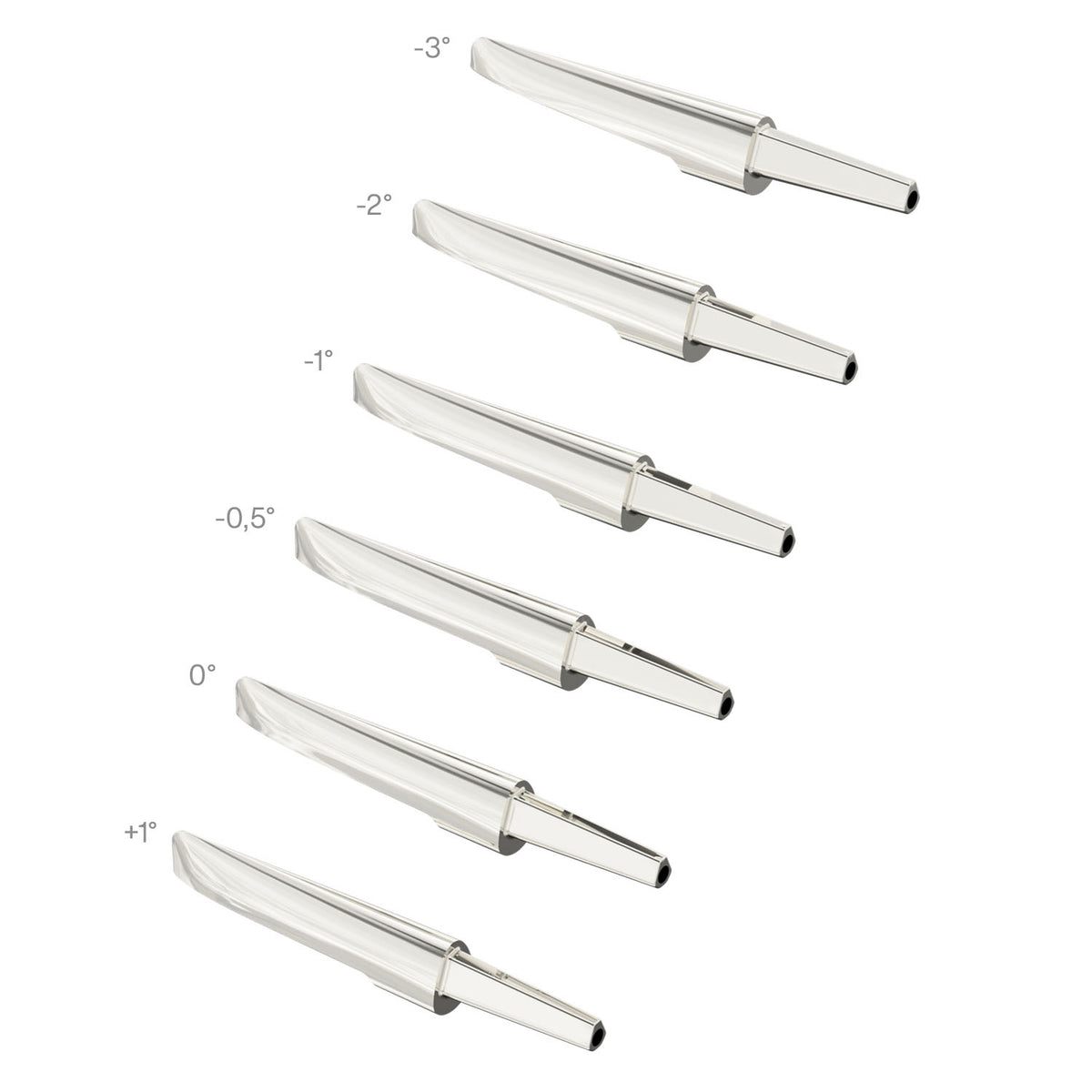
The Veloce XTR works with dedicated Lower tail wings in XS, S, M, and L. They are placed under the fuselage to reduce drag and preserve the efficiency of this highly specialized architecture.
The XS maximizes speed and glide.
The S offers very high efficiency with a bit more control.
The M provides a balance between stability, glide, and committed handling.
The L gives more support, more comfort, and more stability for large front wings or weaker conditions.
These Lower tail wings are dedicated to this architecture. They do not mount like classic upper tail wings and must be chosen in coherence with the front wing, size, skill level, and program.
The right Veloce XTR setup is the one that allows maintaining very high speed, crossing flatter areas, surpassing bumps, and keeping control.
Downwind is a committed practice that often takes place far from shore, with wind, current, swell, and long trajectories. Before setting off, always check that the conditions are suitable for your skill level, equipment, and physical condition.
These tips are given as an indication and never replace your judgment, local regulations, or recommendations from competent authorities. Each spot is different: find out about the weather, currents, prohibited areas, tide times, exit possibilities, and specific risks of the course.
Before each run, carefully check your equipment: foil condition, screw tightness, leash condition, foil attachment to the board, condition of the wing, lowkite, or paddle, communication device autonomy, and accessibility of safety equipment.
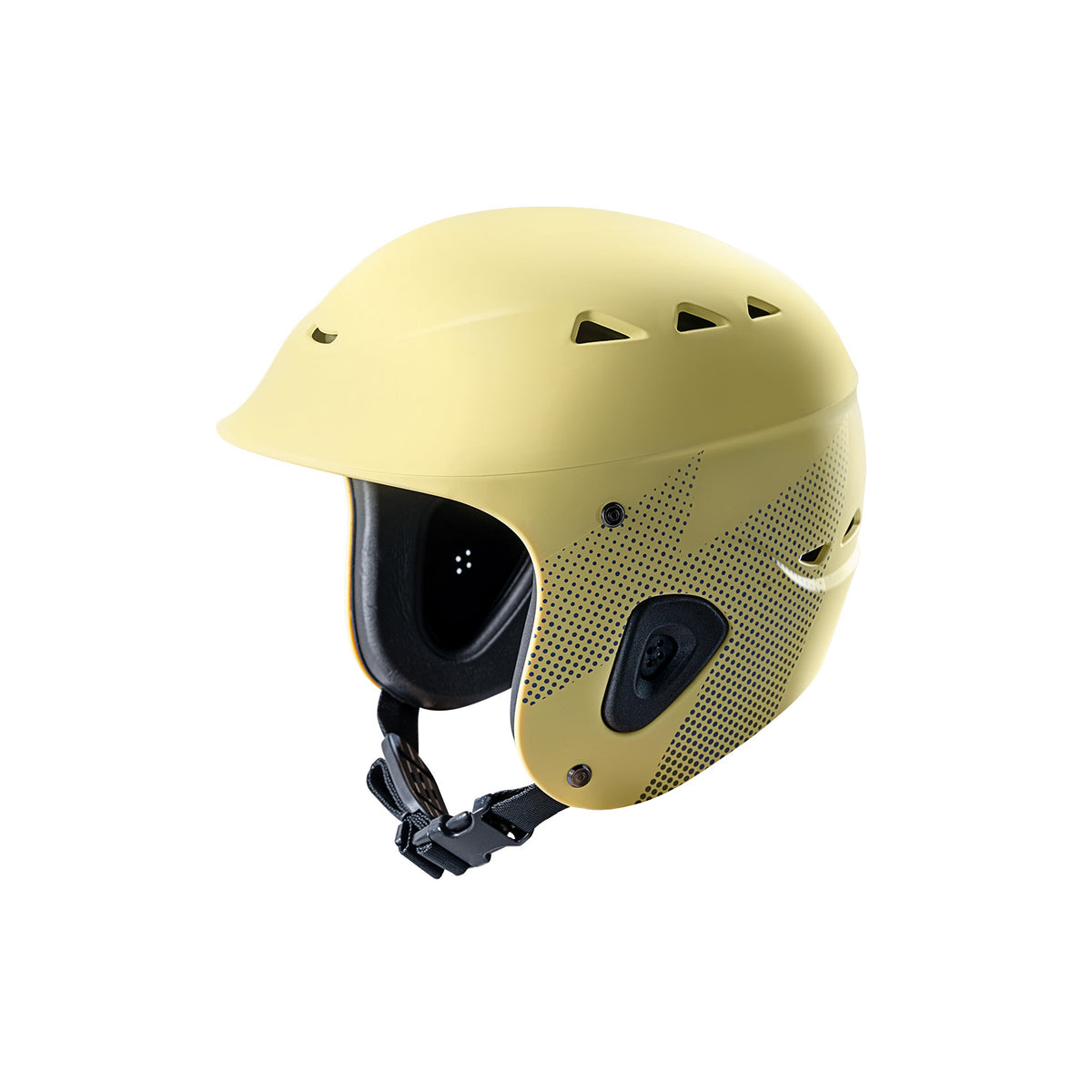
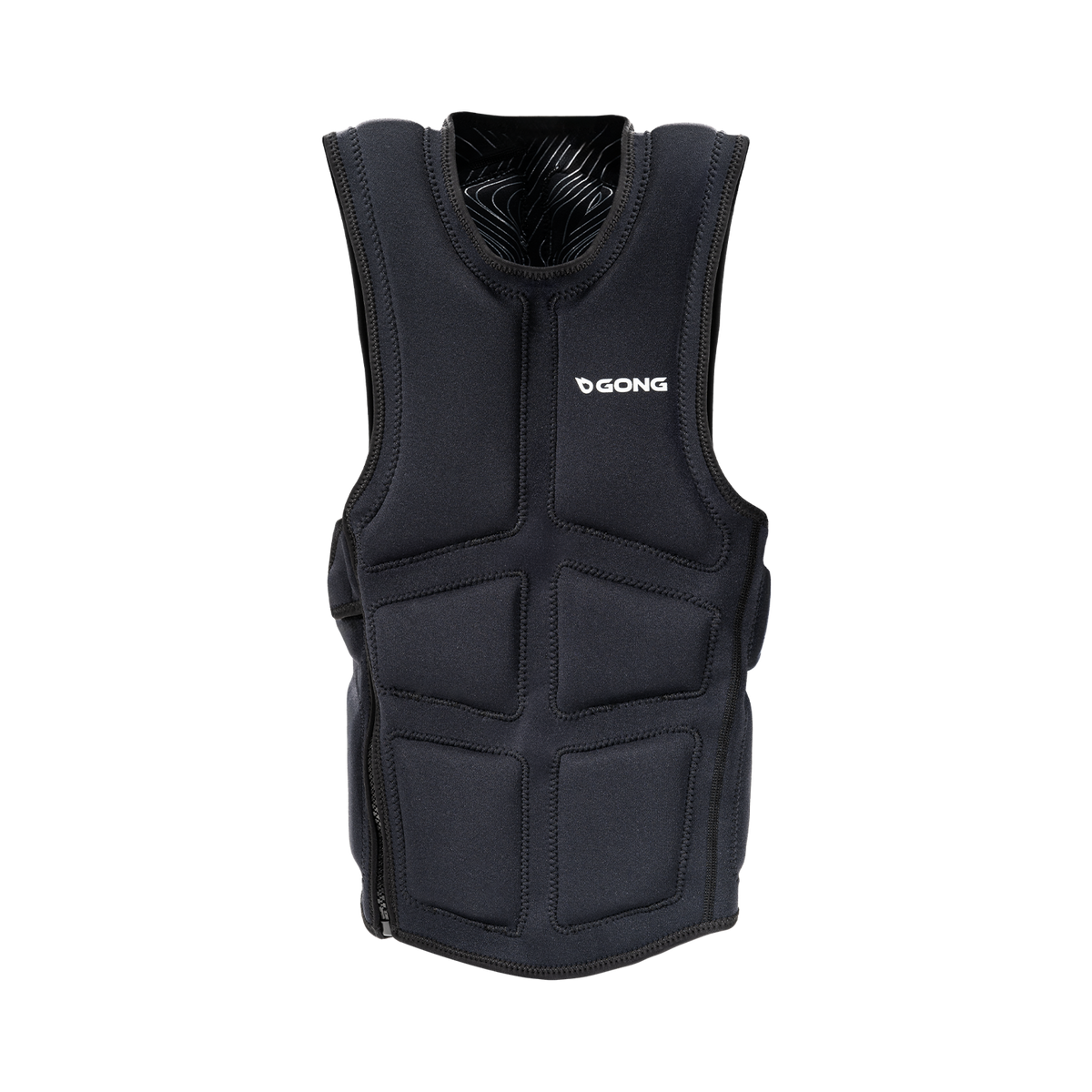
Never set off without suitable safety equipment: impact vest or buoyancy aid, reliable leash, waterproof and charged communication device, visible tracking system, water, appropriate thermal protection, distress flare, line cutter, and possibly a helmet depending on conditions. Train in first aid, it's essential for you and your partners.
Your equipment must also be clearly identified with your name and phone number. In case of loss or separation from your board, this facilitates reporting, return, and avoids unnecessary sea searches.
Always inform someone on land of your itinerary, departure time, and estimated arrival time. Avoid setting off alone, especially on a new course. Ride with riders of equivalent skill level, never alone, maintain regular visual contact, and have a plan B in case of breakage, fatigue, weather change, or inability to reach the destination.
In downwind, the best equipment is the one that allows you to return safely. Prepare your run, stay humble in the face of the water, and always keep some margin.
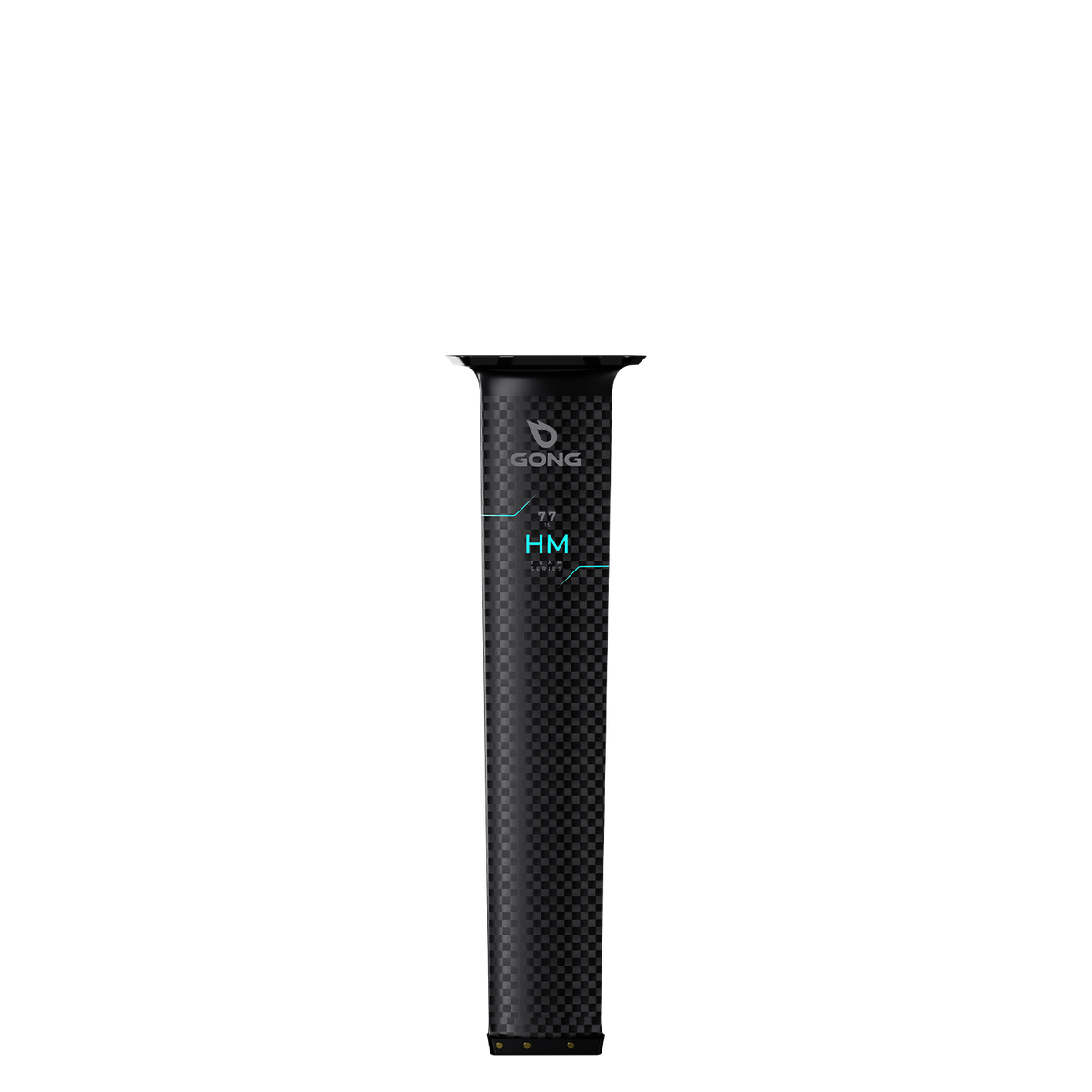
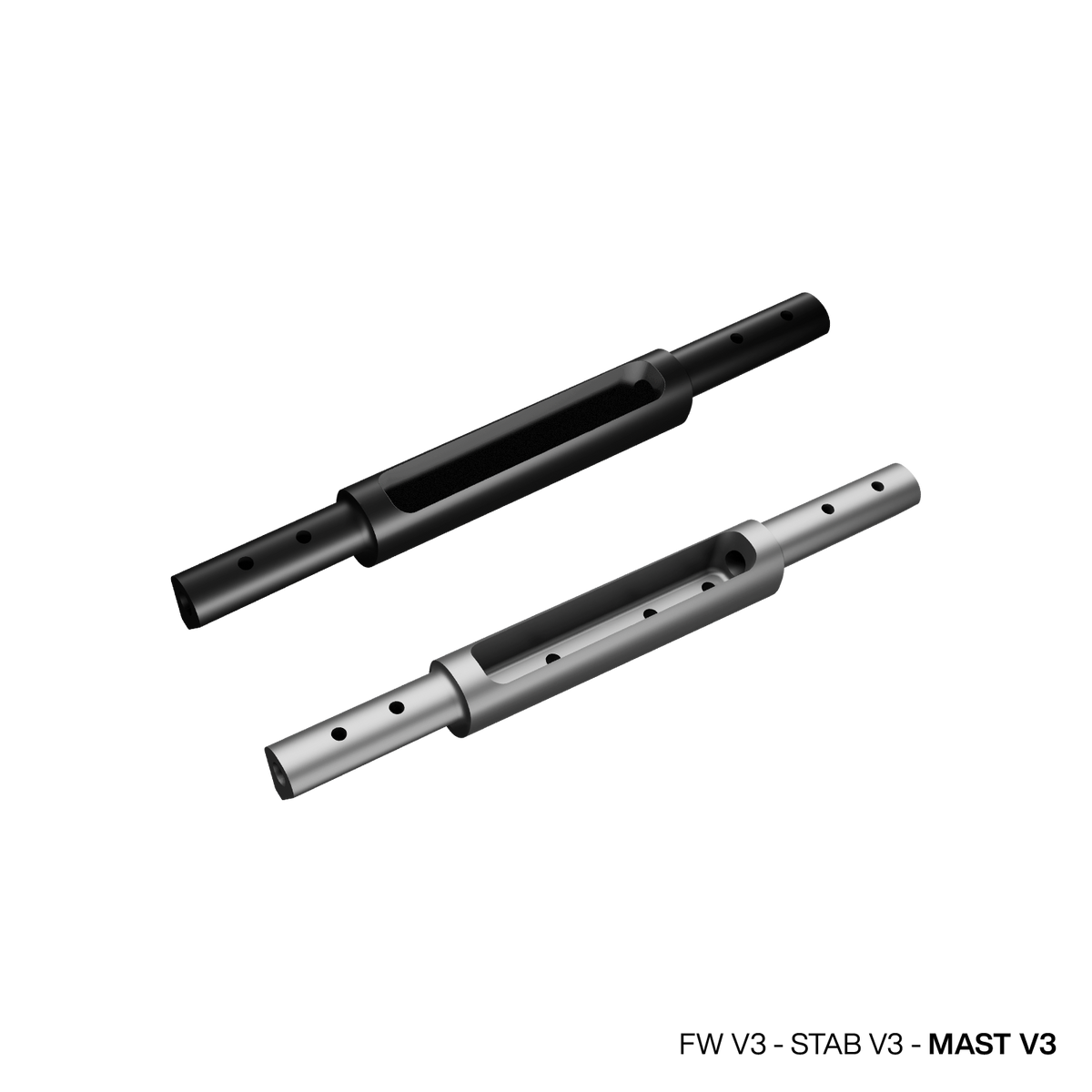
The front wing comes with all the necessary screws for mounting on the fuselage.

















No. It is aimed at expert and professional riders who already know how to exploit the water at high speed, manage their glide, and choose fast lines. To learn, choose a more accessible, more buoyant, and more forgiving wing.
The Veloce DW is more manoeuvrable, forgiving, and versatile. The XTR is more extreme, faster, more rigid, and geared towards records or intense runs. DW = accessible fast downwind. XTR = pure speed and extreme performance.
No, that's not its focus. It can change lines and remain controllable thanks to its shape, but it's designed to track, maintain speed, and glide over bumps. For more fun carves, opt for the Veloce DW.
Yes, but only with a fast and expert approach. It retains a lot of inertia and glides very quickly, but it's not a cool freefly wing. You need space, speed, and real skill.
Technically yes, it will fly. It will be great for downwind/freefly with the wing's pull just for the upwind. But it's not designed for light wind, easy low end, or freeride. For these uses, a Veloce DW, a Veloce LW, a Sirus, or a more suitable wing would be more appropriate.
This is not its program. It can pump between two bumps, but if your goal is dockstart, slalom pumping, or distance on flat water, the Hyper Trail, Supra Trail, or Ultra Trail will be more suitable.
Choose larger for more lift even if it carries a lot, more margin in flatter areas, and more comfort in soft or spaced bumps. Choose smaller if you have the skill, the starting speed, and the conditions to maintain a very high speed.
A dedicated tail wing Lower. The XS maximises speed, the S adds a bit of control, the M balances stability and glide, and the L provides more support for larger front wings or weaker conditions.


