Your cart is empty!
It's flat around here...


The carbon downwind race Tail Wing that minimises drag to overtake bumps, maintain extreme speed and cover more distance with less energy.
The Veloce XTR V3 Atmo Pro Team Series Tail Wing is developed for downwind race, when every acceleration, every metre of glide and every bit of energy saved counts.
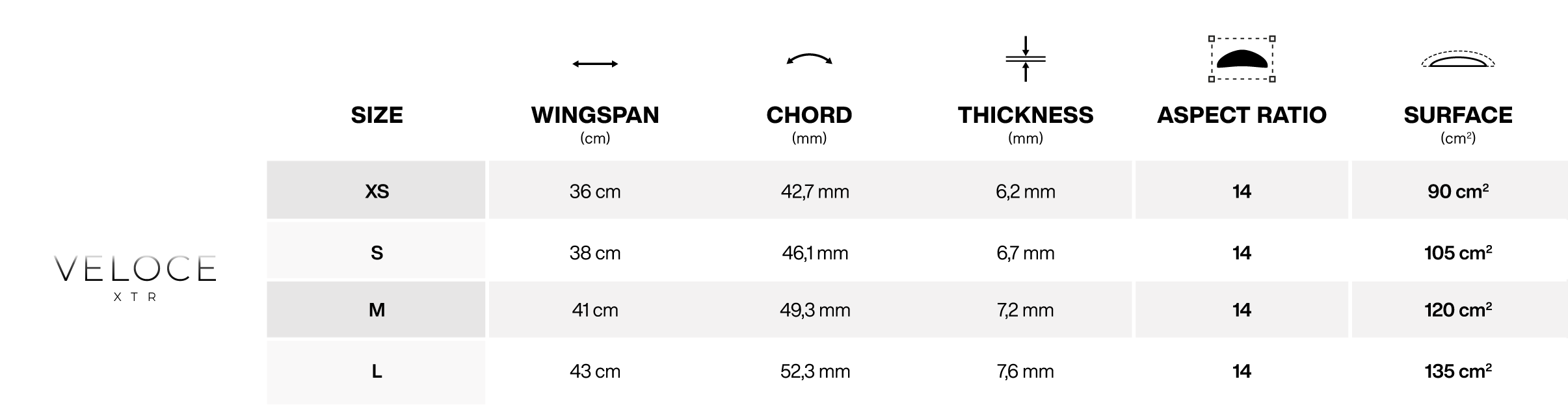
Its very high 14.0 aspect ratio reduces induced drag to an absolute minimum. The foil accelerates instantly on the slope, overtakes bumps and keeps enough speed to cross less supportive sections without repeated speed build-ups.
Its balance is deliberately tuned to generate very little front foot lift. The foil drops freely down the bumps without excessively lifting the board’s nose, never slowing down, which reduces strain on the front leg and keeps handling smooth on long runs.
Its thicker, more powerful and relatively neutral profile keeps the support needed to control take-offs, transitions and pitch changes. Hardly affected by saturation, it stays perfectly locked in as the foil accelerates, letting the Front Wing develop its full speed.
Its extremely stretched outline stabilises lines at high speed and frees up yaw. The area retained through the centre maintains precise support at the core to control pitch and commit to line changes despite the extreme thinness of the tips.
Its Lower architecture positions the Tail Wing farther from the surface and frees up its upper surface. The tips have more margin before breaching, ventilation happens later and the behaviour stays cleaner through acceleration.
Built in CNC-machined monolithic T700 carbon, it holds its profile and angle of attack with extreme precision under heavy loads. This maximum stiffness is essential to unlock the efficiency of a 14.0 ratio Tail Wing.
The reference setup with a Long Tail Shaft and 0° Tail Shim maximises drive, longitudinal stability and long lines.
Paired with the Veloce XTR Front Wing, it creates our fastest and most efficient downwind race foil setup.
In wing foiling and lowkite, this combo delivers another way to fly: little power underfoot, but lift generated constantly by exceptional glide. The foil keeps moving forward and flows through transitions with incredible smoothness. The ultimate glide.
The Veloce XTR V3 Atmo Pro Team Series Tail Wing is aimed at expert riders looking for maximum efficiency in performance downwind and downwind racing.
It is developed for riders who already know how to manage pitch, flight height and speed changes with precision. Its 14.0 aspect ratio cuts drag dramatically, but offers less presence and less margin at low speed than a Veloce DW.
It suits racers who want to overtake bumps, maintain a very high average speed and save energy over the course of a run.
It also speaks to expert wing foilers and lowkite riders who want to discover a very different aircraft from the usual powerful combos: little pressure underfoot, but glide that continuously generates lift.
The Veloce XTR is designed first and foremost for downwind racing. It lets you accelerate hard on every slope, overtake the bumps that choke your line, and keep enough speed to connect to the next ones. It is like running downhill.
Its minimal drag reduces the number and intensity of the speed build-ups needed. The rider relies more on speed and the energy in the water state, and spends less energy maintaining flight.
Its low nose-up effect lets the board follow the slopes naturally. The front leg works less to contain the aircraft, and control stays smoother on long descents.
In wing foiling and lowkite, it delivers an especially smooth, gliding feel. Paired with a Veloce XTR Front Wing, it gives little power underfoot at low speed, but the glide quickly generates the lift needed for flight. Once up to speed, the combo keeps moving forward all the time, holds high speed through lulls, and delivers exceptional glide through transitions.
It can also be used for pure pumping on flat water by an expert rider. Its efficiency is extremely high, but this remains a niche use and requires precise cadence as well as excellent height control.
The Veloce XTR is not a progression Tail Wing. It requires excellent control of the aircraft and offers less margin in take-offs, slow phases and pitch mistakes.
To build your pumping foundations, choose a Trail. For more dynamic, playful pumping, a Hyper Trail will be better suited. For long-distance flat-water pumping, go for a Supra Trail or an Ultra Trail depending on your level.
For high-performance downwind with more support, versatility and low-speed control, the Veloce DW is a more accessible option.
For committed surf foiling, snaps, tight carves and landings, choose a Ypra Surf Carve Tail Wing or a more surf-oriented model.
If you are looking for a lot of power underfoot in wing foiling or lowkite, the Veloce XTR will not match that feeling. It works through speed and glide, not through heavy support.
Size choice depends on the Front Wing, rider weight, target speed and the level of control you want.
A larger Veloce XTR keeps more support in take-offs, transitions and speed changes. It stabilises pitch and makes control easier, but generates slightly more drag.
A smaller size cuts drag even further, frees up speed and reduces pressure on the front foot. On the other hand, it requires extremely precise pitch control and becomes more demanding when the aircraft slows down.
The best choice is not automatically the smallest size. A Tail Wing that is too small can force the rider to make constant corrections, lose height and waste more energy than it saves in drag reduction.
In racing, choose the smallest size you can control cleanly over the whole course, not just in the fastest sections.
The Veloce XTR is offered exclusively in a Lower architecture.
It works with a Lower Tail Shaft paired with a Lower Shim Tail. It cannot be mounted on an Upper Tail Shaft or an Upper Shim Tail.
The reference setup uses a Long Tail Shaft and a 0° Lower Shim Tail. This combination maximises drive, stabilises pitch and lets you make full use of the aircraft's speed over very long lines.
Always start with this setup before trying to free the foil up further. It delivers the behaviour intended by the designer and lets you identify the effect of each change precisely.
The Lower setup places the Tail Wing farther from the surface when the aircraft is flying high.
This position gives more margin before a tip comes out of the water. It delays ventilation and makes acceleration safer when the foil is being ridden very close to the surface.
The upper surface also stays better fed and less exposed to turbulence coming from the Front Wing and the rear system.
At very high speed, this flow quality limits saturation, keeps the response more consistent and reduces the feeling of resistance at the rear.
The 0° Shim Tail keeps the reference incidence calculated for the Veloce XTR.
It does not mean the Tail Wing is horizontal relative to the fuselage. The incidence required for the model to work is built directly into its carbon base.
The Shim Tail number only indicates the angle added or removed relative to this reference.
So 0° is always the best starting point for understanding the aircraft's balance before changing front-foot pressure or its longitudinal behaviour.
Start with a 0° Lower Shim Tail, which corresponds to the Veloce XTR's reference setting.
A negative angle number increases the Tail Wing's nose-up effect. It adds front-foot pressure and more presence in take-offs or slow phases, but also increases drag and limits some of the efficiency being sought.
The -0.5° can correct a combo that is slightly lacking in front-foot pressure or low-speed support. Larger values move well away from the XTR's natural programme.
The +1° reduces front-foot pressure even further and frees up the aircraft at high speed. It does, however, require more rear-foot control and makes take-offs, transitions and slowdowns much more technical.
In racing, the fastest setting is not always the one that produces the least front-foot pressure. You need to keep enough support to control the aircraft and use all its speed without constant corrections.
Start with a 0° Lower Shim Tail, which corresponds to the Veloce XTR's reference setting.
A negative angle number increases the Tail Wing's nose-up effect. It adds front-foot pressure and more presence in take-offs or slow phases, but also increases drag and limits some of the efficiency being sought.
The -0.5° can correct a combo that is slightly lacking in front-foot pressure or low-speed support. Larger values move well away from the XTR's natural programme.
The +1° reduces front-foot pressure even further and frees up the aircraft at high speed. It does, however, require more rear-foot control and makes take-offs, transitions and slowdowns much more technical.
In racing, the fastest setting is not always the one that produces the least front-foot pressure. You need to keep enough support to control the aircraft and use all its speed without constant corrections.
The Veloce XTR Front Wing is the reference pairing. This combo creates the fastest and most efficient downwind race aircraft in the range.
The Veloce XTR Tail Wing can also be paired with a Veloce DW to maximise speed and high-speed stability, with less support in slow phases than a Veloce DW Tail Wing.
With a Veloce FF or a Veloce LW, it greatly frees up glide in wing foiling and lowkite. This setup suits expert riders looking for a high average speed and a very smooth aircraft rather than strong power underfoot.
Pairing it with an Ultra Trail Front Wing is technically possible for pure pumping. It then delivers extreme efficiency, but requires very precise control and remains marginal compared with Tail Wings specifically developed for pumping.
Paired with the Veloce XTR Front Wing, the Veloce XTR Tail Wing gives an aircraft with very little power underfoot at low speed.
You should not try to ride it like a foil that rises through heavy pressure on the front foot. You need to let it accelerate. Speed gradually generates lift and the aircraft starts flying with very little resistance.
This feeling is extremely smooth and enjoyable. The foil keeps moving forward all the time, holds its energy through lulls, and delivers exceptional glide when the pull disappears in transitions or in freefly.
The Veloce XTR Front Wing is natively set 2 cm farther back. So for use in wing foiling or lowkite, move your mast forward by around 2 cm compared with your usual position, then fine-tune this setting according to your board, your stance and the pressure you are looking for.
Start with the reference combo, a Long Tail Shaft and a 0° Shim Tail.
Use this setup long enough to understand the low front-foot pressure, the high-speed stability and the aircraft's behaviour in take-offs and transitions.
Then only change one element at a time. A change in Tail Wing size, Tail Shaft length, Shim Tail or mast position can deeply alter the overall balance.
Look for an aircraft that accelerates freely while remaining controllable when speed drops. Minimal drag brings nothing if it forces constant corrections or prevents you from holding a clean line.
In downwind racing, the best setting is the one that lets you stay high, overtake bumps and maintain your speed all the way to the finish with the fewest unnecessary movements.
The Veloce XTR Tail Wing is exclusively Lower.
It works with:
V3 and Micro V3 Atmo Tail Shafts and Shim Tails are not interchangeable on the fuselage side.
The Tail Wing remains compatible with both diameters thanks to its standard interface. You must use the Tail Shaft and Shim Tail matching the fuselage diameter.
It cannot be mounted on an Upper Tail Shaft, an Upper Shim Tail or an Upper wedge.
Each pack comes with all the screws needed for assembly.
Tail Shaft:
Shim Tail