


Pack Tail Wing Lower Veloce Downwind V3 Atmo
The full-glide Tail Wing setup to free up the foil in downwind, wing foiling and lowkite.
See Description
Regular Price
$374
Sale Price
$374Regular Price
$395
-5%
ref : GON26PACKTAILWINGLOWERVELOCEDW
france
Quality boards conceived in France
Direct sale from shaper to surfer
Pay in multiple installments


Description
Programme
The carbon Tail Wing that frees up the foil’s glide in downwind, wing foiling and lowkite, with low front foot pressure and enough support to stay in control through slower phases.
Overview
The Veloce DW V3 Atmo Pro Team Series Tail Wing is designed to free up the foil’s glide in downwind while keeping the support needed for early take-off, linking bumps and controlling line changes.
Its 12.0 aspect ratio significantly reduces drag and lets the foil carry its energy between pressure phases, descents and pulls. The foil accelerates naturally, holds a high average speed and keeps moving without any feeling of rear-end drag.
Its balance is deliberately tuned to put very little load on the front foot. The foil naturally follows the slope of the bumps without lifting the board’s nose excessively, which reduces corrections and makes long lines feel smoother.
Its medium-thickness, heavily cambered profile keeps solid support at low speed. It makes take-offs, transitions, bump changes and speed build-up more secure without holding back the Front Wing’s acceleration.
Its very elongated outline frees up yaw and naturally smooths out rail-to-rail behaviour. The retained surface area through the centre provides clear, readable support at the core, around which the foil still rolls easily into carves and direction changes.
Its Lower architecture positions the Tail Wing below the Shim Tail, further from the surface and away from the Front Wing’s turbulence. Its upper surface stays better fed, the tips are less sensitive to breaching, and the foil keeps more margin in choppy, disorganised water.
Built in monolithic CNC-machined T700 carbon, it holds its profile with great precision under heavy loads and transmits every input directly. This maximum stiffness unlocks the full potential of its shape in acceleration and speed build-up.
The reference setup with a Long Tail Shaft and 0° Shim Tail maximises stability, extends the lines and makes full use of its efficiency.
Paired with Veloce DW, Veloce XTR, Veloce FF or Veloce LW Front Wings, it creates a fast, natural and highly efficient foil in downwind, freefly, wing foiling and lowkite in light wind. It can also free up a Sirus or a Fluid when the goal is to reduce front foot pressure and favour natural glide.
Buying guide
For whom?
The Tail Wing Veloce DW V3 Atmo Pro Team Series is aimed at experienced to expert riders who want to unleash the glide of their plane without falling into the extreme demands of a Tail Wing of downwind race.
It is suitable for downwinders looking for high average speed, long trajectories and a plane that naturally follows the slope of the bumps with little pressure in the front foot.
She also speaks to wingfoilers and lowkiters who use very slippery Front Wings in light wind, in freeflying or in navigations where energy conservation is more important than rear power.
Its high ratio, low drag and Lower assembly nevertheless require good control of the attitude and flight height. It remains more accessible than the Veloce XTR, but it is not designed like a Tail Wing of progress.
For what ?
The Veloce DW is primarily developed for downwind. It allows the plane to accelerate on each slope, maintain its speed between two bumps and cross less buoyant areas more easily.
Its low pressure in the front foot lets the board naturally follow the slope without excessively lifting the nose. The rider constantly pushes less on the front leg and can concentrate on his trajectory, his reading of the water and the choice of the next bump.
In wingfoiling and lowkiting in light wind, it releases the Front Wings Veloce FF, Veloce LW and Veloce DW. It favors average speed, ascent in soft areas and freeflying with a plane that conserves its energy.
It is also suitable for freeride navigation when the rider is looking for a Tail Wing fluid, lightly loaded on the front foot and more controllable at low speed than an XTR model.
Finally, it’s an excellent shape for surfing and carving with style. It is powerful enough not to be erased, with no tips for maneuvering, so with a Veloce FF for example, it is an excellent combo for putting super curves in a sluggish swell. With this in mind, oversize the tail by two sizes wing compared to the front wing. XL for M in front for example.
It's also a very good size wing pure pumping, combining relative simplicity with high-level gliding.
The versatility is total and at the best level.
Avoid if...
The Veloce DW is not the best solution for building the foundations of pumping on the flat. Even if she can function perfectly in this discipline, her main program remains downwind and glide-oriented wind sports.
To progress in dockstart, beach start or flat start with a lot of support at very low speed, choose a Tail Wing Trail.
For more dynamic pumping, short carves and slalom on the flat, the Hyper Trail will be more suitable.
For committed surf foiling, snaps, tight curves and landings, prefer a Tail Wing Ypra Surf Carve or a more wave-oriented model.
If you are looking for maximum speed in downwind racing with very precise steering, the Veloce XTR will go further in performance and stability at high speed.
What size?
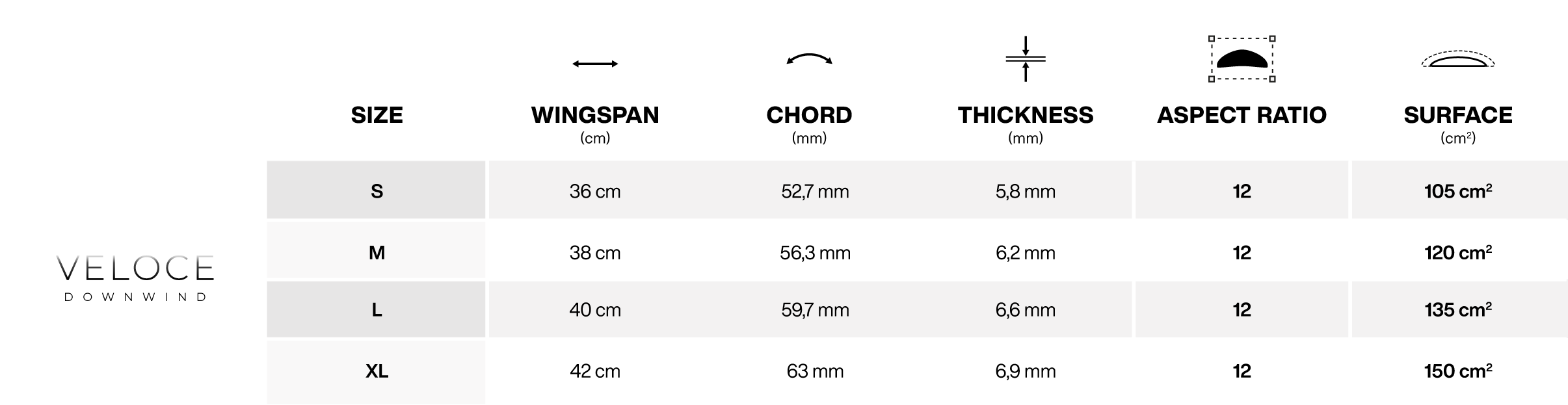
The choice of size depends on the Front Wing, the weight of the rider, the support used, the average speed sought and the level of control desired.
A big tail Wing Veloce DW provides more support at low speed, longitudinal stability and presence in transitions. It makes starts easier and makes bump changes safer, but produces more drag.
A small size frees up more speed, reduces the front foot and makes the plane livelier. In return, it requires more precision in the management of the base, restarts and slow phases.
The best choice is not always the smallest size. In downwind, a plane that is too free can require permanent corrections and waste more energy than a Tail Wing slightly larger but perfectly controlled.
The size must remain consistent with that and the program of the Front Wing. Plus the Front Wing is large, load-bearing and used at low speed, the more the Tail Wing must maintain enough surface area to control the aircraft.
Note that with a Veloce FF for example it is an excellent combo for putting super curves in a sluggish swell. With this in mind, oversize the tail by two sizes wing compared to the front wing. XL for M in front for example.
What assembly?
In this configuration, the tail wing is in Lower mount.
It works with a Tail Shaft Lower associated with a Shim Tail Lower. It cannot be mounted on a Tail Shaft Upper or a Shim Tail Upper.
The reference assembly uses a Tail Shaft Medium and a Shim Tail Lower 0°. It offers the best balance between stability, ease, cadence and performance to discover the Tail Wing and understand their behavior.
Why a lower assembly?
The Lower assembly places the Tail Wing below the Shim Tail, therefore further from the surface when the plane is flying high.
This position provides more margin before a tip comes out of the water. It delays ventilation phenomena and allows you to maintain cleaner support in a disordered body of water or during a rapid change of trim.
The upper surface of the Tail Wing is also freer and less exposed to disturbances coming from the Front Wing and rear system. The sliding sensation is more natural, with very little perceptible resistance.
This setup is particularly relevant in downwind, freefly and in programs where the plane must conserve energy while flying close to the surface.
What does Shim Tail 0° mean?
The Shim Tail 0° maintains the reference incidence calculated for the Veloce DW.
It does not mean that the Tail Wing is horizontal in relation to the fuselage. The bearing necessary for its operation is directly integrated into its carbon seat.
The Shim Tail number only indicates the variation applied compared to this reference.
0° is therefore always the best starting point before modifying the front foot, the attitude or the general character of the aircraft.
Which angle to choose?
Start with the Shim Tail Lower 0°, which is the reference setting of the Veloce DW.
A negative angle number gradually increases the nose up effect of the Tail Wing. It adds front foot, makes it easier to lift the plane and gives more presence in slow phases, but increases drag and can counteract the natural behavior sought in downwind.
The -0.5° can be used when a combo is slightly lacking in front foot or startup support. Higher values must meet a specific need and are rarely necessary with a correctly chosen size.
The +1° reduces the pressure in the front foot and further frees up gliding. However, it requires more control from the back foot and can make starts, transitions and slow phases more demanding.
The right angle depends on the forehead Wing, its size, the length of the Tail Shaft, the position of the foil in the boxes and your way of riding. Only change one setting at a time.
What length of Tail Shaft?
The Tail Shaft Long is the reference assembly of the Veloce DW.
Its upper lever arm stabilizes the trim, makes height variations more progressive and lengthens trajectories. It fits particularly well with downwind Front Wings, whose large wingspans and performance require a clean and guided aircraft.
A Medium Tail Shaft makes the plane more compact, sharper in pitch and easier to tilt in short trajectories. It can be chosen with smaller Front Wings or for more wingfoil and freeride oriented use.
The Tail Shaft Short is a clear departure from the natural behavior of the Veloce DW. It makes the plane much livelier and reduces the desired longitudinal stability in downwind. It must be reserved for very specific associations and objectives.
A greater length does not directly provide more glide. It mainly improves the control, progressiveness and drive of the aircraft, which often makes it possible to exploit the performance of the Front more effectively. Wing.
Which Front Wing ?
The Veloce DW naturally pairs with the Front Wings Veloce DW and Veloce XTR for downwind. It frees up their glide, limits the front foot and maintains enough support to control bump changes and slow phases.
With a Veloce FF or a Veloce LW, it forms a very effective wingfoil and lowkite plane in light wind. It promotes average speed, freeflying and energy conservation in soft areas.
It can also be combined with a Sirus to reduce the pressure in the front foot and further free up the glide of the plane. This assembly is aimed at a rider who wants to make a great Front Wing more fluid and natural carrier.
With a Fluid, it softens the pressure in the front foot and provides more glide, especially in wingfoil or freefly. However, it reduces some of the very engaged character and rear support specific to a more classic Fluid combination.
It is not the reference association for pure pumping Front Wings like the Ultra Trail. Such a setup can work on the flat for an expert rider looking for a particular sensation, but it remains marginal and does not correspond to the natural program of the two products.
How to progress in the settings?
Start with the Tail Shaft Long, the Shim Tail 0° and a size of Tail Wing consistent with your Front Wing.
Use this setup long enough to understand the pressure in the front foot, the behavior in departures, the stability in traverses and the freedom of the plane at high speed.
Then only change one item at a time. A modification of Shim Tail, Tail Shaft Length, Tail Size Wing or position of the foil in the boxes can profoundly change the general balance.
Look for a plane that moves naturally without becoming unstable in slow phases. Reducing drag only helps if you maintain enough control to exploit that glide.
In downwind, the best setting is the one that allows you to stay high, follow bumps without permanent corrections and conserve energy throughout the duration of the run.
Compatibility
In this configuration, the tail wing is in Lower mount.
It works with:
- a Tail Shaft V3 Lower and a Shim Tail V3 Lower; a Tail Shaft Micro V3 Atmo Lower and a Shim Tail Micro V3 Atmo Lower.
The V3 and Micro V3 Atmo Tail Shafts are not interchangeable on the fuselage side.
The Shims Tails can be mounted either on Tails Shafts V3 or Micro V3.
The Tail Wing remains compatible with both diameters thanks to its standard footprint. You must use the Tail Shaft corresponding to the diameter of the fuselage.
It cannot be mounted on a Tail Shaft Upper, a Shim Tail Upper.
Downwind Safety
Downwinding is a committed practice which often takes place far from the edge, with wind, current, swell and long trajectories. Before leaving, always check that the conditions are suitable for your level, your equipment and your physical condition.
This advice is given for information purposes only and never replaces your judgment, local regulations or the recommendations of the competent authorities. Each spot is different: find out about the weather, currents, prohibited areas, tide times, exit possibilities and the specific risks of the route.
Before each run, carefully check your equipment: condition of the foil, tightening of the screws, condition of the leash, attachment of the foil to the board, condition of the wing, lowkite or paddle, autonomy of the means of communication and accessibility of safety equipment.
Never leave without suitable safety equipment: impact vest or buoyancy aid, reliable leash, waterproof and charged means of communication, visible tracking system, water, suitable thermal protection, distress flare, line cutter and possibly helmet depending on the conditions. Train yourself in first aid, it is essential for you and your partners.
Your equipment must also be clearly identified with your name and telephone number. In the event of loss or separation from your board, this makes it easier to report and return and avoids unnecessary searches at sea.
Always inform someone on land of your itinerary, your departure time and your estimated time of arrival. Avoid going alone, especially on a new route. Sail with riders of equivalent level, never alone, keep regular eye contact and have a plan B in case of breakage, fatigue, change in weather or inability to reach the finish point.
When downwinding, the best equipment is the one that allows you to return home with peace of mind. Prepare your run, stay humble in front of the water and always keep some margin.
Equipments
Each pack comes with all the screws needed for assembly.
Tail Shaft:
- 2 M6 x 25 mm T30 screws for the V3 SuperLock connection to the fuselage;
- 1 screw for the Shim Tail connection from inside the Tail Shaft, with a length depending on the setup:
- M6 x 50 mm T30 for sizes S and M
- M6 x 100 mm T30 for size L
Shim Tail
- 2 M6 x 14 mm T30 screws to fasten the Tail Wing to the Shim Tail;
- 1 additional M6 x 12 mm T30 screw to replace the rear screw on the thinnest tail wings.
Delivery
GONG | Pack Tail Wing Lower Veloce Downwind V3 Atmo