Your cart is empty!
It's flat around here...


The adjustable carbon Tail Wing that supports your full progression in pump foiling, from your first dock starts to long-distance runs, with plenty of support, control and ease, even at very low speed.
The Trail V3 Atmo Team Series Tail Wing has been developed to make pump foiling easier, less physical and more efficient at every stage of progression.
It is primarily designed to support your first dock starts, and even beach starts, flat starts and your first long-distance runs, with a reassuring foil setup that feels very present under your feet and is easy to keep in rhythm. Its goal is not just to help you get going: it lets you build clean, consistent technique with solid support and superb glide.
Its 8.0 aspect ratio offers an excellent balance between lift at very low speed, efficiency and control. The Tail Wing carries enough speed through each pump to help you progress in distance, without feeling vague or unstable. It is a world away from overly thin or overly demanding tail wings that require a cadence and technique that are simply out of reach at the start of your progression.
Its generous centre chord concentrates support under your feet. The rider finds their balance more easily, quickly understands the pumping rhythm and maintains more consistent flight when foot pressure or cadence is not yet perfect.
Its new Trail Team Series profile is powerful, forgiving and particularly enjoyable at low speed. It smooths out small stance errors, evens out height variations and helps the foil naturally settle back into rhythm after a drop in cadence or a mistake.
Its very slight negative dihedral maximises efficiency while keeping reactions predictable and progressive. The centred, forgiving tips make line corrections easier and build confidence through long sequences.
Built in monolithic T400 carbon, CNC machined, it transmits foot pressure directly and maintains consistent stiffness through the thousands of pumps in a pump foiling session.
Its Upper architecture allows it to be used with a Carbon Tail and its matching shim, or with a Tail Shaft Upper and a Shim Tail Upper. The reference setup with a Tail Shaft Medium and Shim Tail 0° offers the best balance of stability, cadence, efficiency and ease of use.
Paired with a Trail Team Series Front Wing in the same size, it creates a perfectly coherent foil setup to progress naturally, extend your flights and build ever more efficient pumping.


The Tail Wing Trail V3 Atmo Team Series is aimed at riders who want to build, improve and stabilize their pumping technique with a very readable plane, very present at low speed and easy to maintain your rhythm.
It is suitable for users who are new to dockstart, but its program is not limited to the first attempts. It supports all progression towards more regularity, more endurance and more distance.
She also speaks to riders who already know how to pump but are not looking for a Tail Wing extreme. Some prefer a reassuring aircraft, a cool cadence and a regular flight rather than an ultra-fast setup which requires permanent precision.
It is ideal for those who want to repeat many attempts without immediately putting themselves in the red. We start, we fly, we rest and we start again. Progress comes from the quality and repetition of the movement, not just the intensity.
The Tail Wing Trail is developed for pure pumping, dockstart, beach start, flat start and the first long distances on the flat.
In dockstart, it provides the necessary support to stabilize the board from the start, run, jump, straighten the body and set the pace without being immediately overwhelmed by an too unstable foil. It allows you to work on rhythm, posture, amplitude, trajectory, height management and effort saving. It is designed to transform tests into regular flights, then regular flights into distance.
In beach start, it helps to maintain support in the first seconds, when the speed and height are still low. The discipline remains very demanding, but its progressive behavior provides a real margin.
In flat start, it accompanies the launch phase with a lot of support at low speed. This program requires a high technical level and a suitable board, but the Trail forms a coherent whole with the Front Wing Trail Team Series.
The Tail Wing Trail does not aim for maximum speed, absolute records or extreme performance.
If your main objective is slalom pumping, sharp accelerations, buoys and carves on the flat, a Tail Wing Hyper Trail will be more suitable.
If you want to maximize long distances with an already controlled cadence, the Supra Trail will offer more glide and less drag, with more demands.
If you are looking for absolute records and maximum performance, the Ultra Trail is the most extreme solution, but it requires a much higher level of riding.
The Trail can work with other Front Wings, but its main interest remains pumping progress. For downwind, freefly, wingfoil or lowkite, choose a Tail Wing designed for these programs.
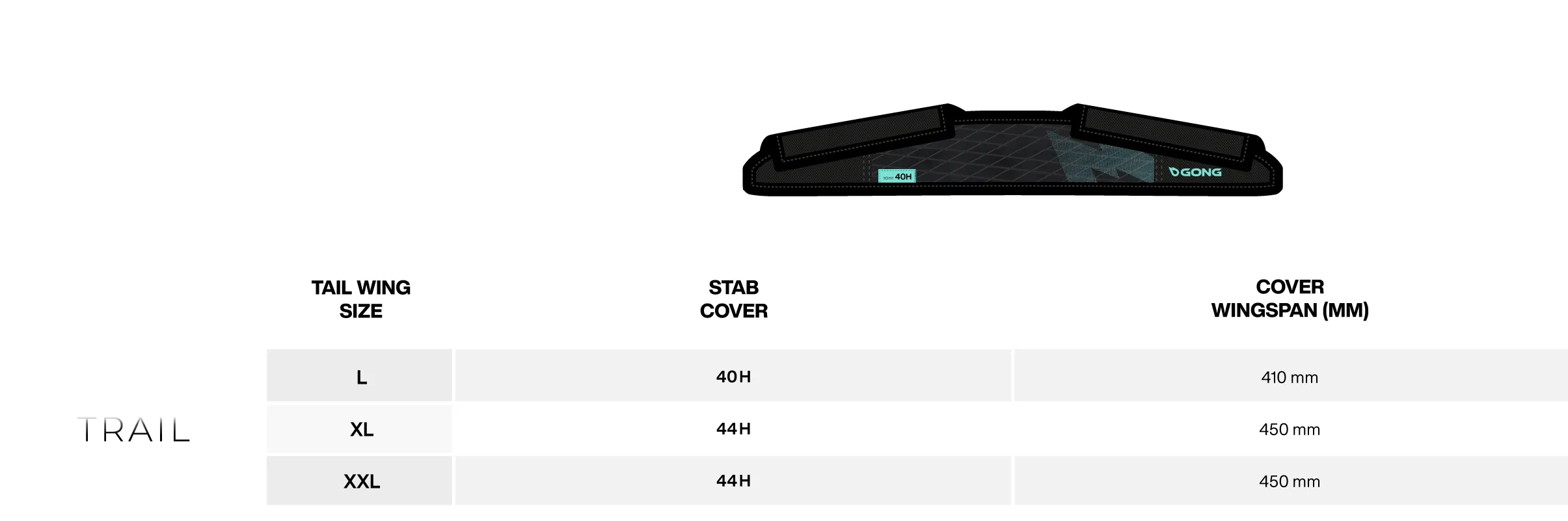
The choice of size mainly depends on the Front Wing used, the weight, the level, the power of the rider and the balance sought.
The reference assembly consists of associating a Tail Wing Trail same size as the Front Wing Trail Team Series. This correspondence maintains the calculated balance between support, stability, cadence and performance.
A Tail Wing larger provides more support at low speed, more longitudinal stability and more presence under the feet. It facilitates control, but also increases drag and may require more front foot.
A Tail Wing smaller reduces drag, frees up speed and makes the plane livelier. On the other hand, it requires better height management, a more precise cadence and more active steering.
The smallest Tail Wing is not systematically the most efficient. When pumping, height management is fundamental. A plane that is too difficult to hold very high can create much more drag with the mast submerged than the reduced surface area of the Tail Wing allows you to win.
The best choice is therefore the one that allows you to fly high, regularly and without permanent corrections.

In this configuration, the tail wing is in Upper mount.
It can be mounted on a Carbon Tail with the corresponding wedge, or on a Tail Shaft Upper associated with a Shim Tail Upper.
It cannot be mounted on a Tail Shaft Lower or a Shim Tail Lower. The Upper and Lower architectures use different geometries and bases.
Tail Shaft and Shim Tail mounting offer the most complete level of customization. The Shim Tail precisely defines the incidence of the Tail Wing and connects the volumes in a continuous hydrodynamic line.
The reference assembly uses a Tail Shaft Medium and a Shim Tail Upper 0°. It offers the best balance between stability, ease, cadence and performance to discover the Tail Wing and understand their behavior.
The Shim Tail 0° maintains the reference incidence calculated for the Tail Wing Trail.
It does not mean that the Tail Wing is horizontal in relation to the fuselage. The native incidence necessary for the operation of the model is directly integrated into its carbon support.
The Shim Tail number only indicates the angle added or removed from this reference.
0° is therefore always the best starting point. It allows you to discover the Tail Wing in the balance intended by the designer before modifying the front leg or the character of the aircraft.
Start with a Shim Tail Upper 0°. This is the reference setting of the Tail Wing Trail.
A negative angle number gradually increases the nose up effect of the Tail Wing. It brings more front foot, makes it easier to start and gives a more eager plane, but it also increases the effort required of the front leg.
The -0.5° is the logical first step when you want a little more front foot or more presence with each kick.
The -1° produces a clearer difference and must be chosen with a precise objective. Rarely effective in pure pumping. The -2° and -3° angles are very radical and rarely necessary with a Tail Wing Trail correctly sized.
The +1° reduces the front foot and lets the plane slide more, but it requires more rear foot and can delay the start. This setting generally deviates from the natural progression program of the Trail.
Tail Shaft length and Shim Tail angle should always be considered together. Only change one setting at a time.
The Tail Shaft Medium is the reference assembly for the Tail Wing Trail. It offers the best compromise between longitudinal stability, cadence, control and efficiency.
The Tail Shaft Short reduces the wheelbase of the aircraft. The foil becomes more lively, reacts more quickly in its trim variations and reduces the curve radii. This setup may be suitable for riders who want more dynamic pumping and already have good precision.
The Tail Shaft Long increases the lever arm of the Tail Wing. The plane becomes smoother, more progressive and more guided. The trajectories become longer and the pace can become more regular over time.
A greater length does not automatically provide more glide. Above all, it brings more stability and progressiveness. The right choice depends on your cadence, stance and riding style.
The Tail Wing Trail is developed as the natural partner of the Front Wing Trail V3 Atmo Team Series.
The reference combo uses a Front Wing and a Tail Wing of the same size. This combination offers the balance expected for progression: lots of support at low speed, good cadence stability, predictable behavior and sufficient performance to extend flights.
It can also be used with a Front Wing Trail Perf Series matched in size to keep the same program in a different construction.
The Tail Wing Trail can work with other Front Wings, but its powerful profile and low-speed presence will always orient the aircraft toward ease, stability, and progression.
With a Forehead Wing faster or finer, it can reassure the general behavior, but it will also increase drag and can limit the maximum speed.
Start with the recommended combo: Front Wing Trail and Tail Wing Trail of the same size, Tail Shaft Medium and Shim Tail 0°.
Use this setup for enough sessions to understand its balance, your natural cadence and the position of the foil in the boxes.
Then only modify one element at a time. Change Tail Shaft Length, Tail Shim Bearing, Tail Size Wing or the position of the foil, but never all these parameters simultaneously.
Look to improve your technique first before systematically reducing the size of the Tail Wing. Clean cadence, good height management and consistent flight produce much more distance than a poorly controlled extreme setup.
An adjustment can also be used to improve your driving. Slightly sharper editing can develop accuracy. A longer edit can learn to smooth out the cadence. The goal is not always to immediately return to your usual comfort, but to progress by understanding the effect of each parameter.
In this configuration, the tail wing is in Upper mount.
It works with:
The V3 and Micro V3 Atmo Tail Shafts are not interchangeable on the fuselage side.
The Shims Tails can be mounted either on Tails Shafts V3 or Micro V3.
The Tail Wing On the other hand, it remains compatible with both diameters, because the impression which receives it is common. You simply need to use the Tail Shaft and Shim Tail adapted to the diameter of the fuselage.
It cannot be mounted on a Shim Tail Lower or a Tail Shaft Lower.
Each pack comes with all the hardware needed for assembly.
Tail Shaft:
Shim Tail