Your cart is empty !
It's flat around here...


The carbon Tail Wing that frees up the foil’s glide in downwind, wing foiling and lowkite, with low front foot pressure and enough support to stay in control through slower phases.
The Veloce DW V3 Atmo Pro Team Series Tail Wing is designed to free up the foil’s glide in downwind while keeping the support needed for early take-off, linking bumps and controlling line changes.
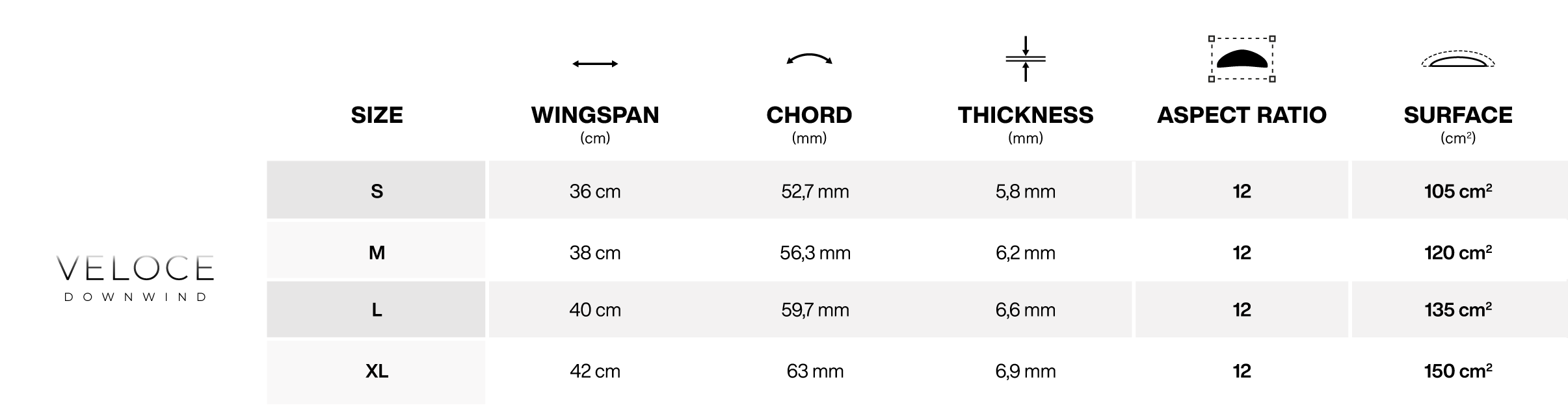
Its 12.0 aspect ratio significantly reduces drag and lets the foil carry its energy between pressure phases, descents and pulls. The foil accelerates naturally, holds a high average speed and keeps moving without any feeling of rear-end drag.
Its balance is deliberately tuned to put very little load on the front foot. The foil naturally follows the slope of the bumps without lifting the board’s nose excessively, which reduces corrections and makes long lines feel smoother.
Its medium-thickness, heavily cambered profile keeps solid support at low speed. It makes take-offs, transitions, bump changes and speed build-up more secure without holding back the Front Wing’s acceleration.
Its very elongated outline frees up yaw and naturally smooths out rail-to-rail behaviour. The retained surface area through the centre provides clear, readable support at the core, around which the foil still rolls easily into carves and direction changes.
Its Lower architecture positions the Tail Wing below the Shim Tail, further from the surface and away from the Front Wing’s turbulence. Its upper surface stays better fed, the tips are less sensitive to breaching, and the foil keeps more margin in choppy, disorganised water.
Built in monolithic CNC-machined T700 carbon, it holds its profile with great precision under heavy loads and transmits every input directly. This maximum stiffness unlocks the full potential of its shape in acceleration and speed build-up.
The reference setup with a Long Tail Shaft and 0° Shim Tail maximises stability, extends the lines and makes full use of its efficiency.
Paired with Veloce DW, Veloce XTR, Veloce FF or Veloce LW Front Wings, it creates a fast, natural and highly efficient foil in downwind, freefly, wing foiling and lowkite in light wind. It can also free up a Sirus or a Fluid when the goal is to reduce front foot pressure and favour natural glide.
The Veloce DW V3 Atmo Pro Team Series Tail Wing is aimed at advanced to expert riders who want to free up their foil's glide without stepping into the extreme demands of a downwind race Tail Wing.
It suits downwind riders looking for high average speed, long lines and a foil that naturally follows the face of the bumps with very little front foot pressure.
It also speaks to wing foilers and lowkite riders using very high-glide Front Wings in light wind, in freefly or in sessions where energy retention matters more than rear foot power.
Its high aspect ratio, low drag and Lower setup still require solid control of pitch and flight height. It remains more accessible than the Veloce XTR, but it is not designed as a progression Tail Wing.
The Veloce DW was developed first and foremost for downwind. It allows the foil to accelerate on every slope, maintain speed between bumps and cross lower-lift sections more easily.
Its low front foot pressure lets the board naturally follow the slope without lifting the nose too much. The rider spends less time constantly pushing on the front leg and can focus on line choice, reading the water and picking the next bump.
In wing foiling and lowkite in light wind, it frees up the Veloce FF, Veloce LW and Veloce DW Front Wings. It promotes average speed, getting back up through the lulls and freefly with a foil that retains its energy.
It also works well for freeride sessions when the rider is looking for a smooth Tail Wing with low front foot load and more low-speed control than an XTR model.
Lastly, it is an excellent shape for surfing and carving with style. It has enough power not to get washed out, with fine tips for manoeuvrability, so paired with a Veloce FF for example it makes an excellent combo for laying down superb carves in weak swell. With that in mind, size the tail wing up by two sizes compared to the front wing. XL with an M front wing, for example.
It is also a very good pure pumping tail wing, combining relative ease with top-level glide.
Its versatility is total, and at the highest level.
The Veloce DW is not the best option for building the basics of flat water pumping. Even though it can work perfectly well in that discipline, its main focus remains downwind and wind sports built around glide.
To progress in dockstart, beach start or flat start with lots of support at very low speed, choose a Trail Tail Wing.
For more dynamic pumping, short carves and flat water slalom, the Hyper Trail will be better suited.
For committed surf foiling, snaps, tight carves and landings, go for a Ypra Surf Carve Tail Wing or a more wave-oriented model.
If you are looking for maximum speed in downwind race with very precise handling, the Veloce XTR will go further in efficiency and high-speed stability.
Size choice depends on the Front Wing, rider weight, the craft used, the target average speed and the level of control you want.
A large Veloce DW Tail Wing brings more support at low speed, more pitch stability and more presence through transitions. It makes take-offs easier and secures bump changes, but creates more drag.
A smaller size frees up more speed, reduces front foot pressure and makes the foil more lively. In return, it requires more precision in pitch control, speed build-up and slow phases.
The best choice is not always the smallest size. In downwind, a foil that is too free can require constant corrections and waste more energy than a slightly larger Tail Wing that is perfectly under control.
The size must stay consistent with the size and programme of the Front Wing. The bigger, more lifting and lower-speed the Front Wing is, the more the Tail Wing needs to keep enough surface area to control the foil.
Note that with a Veloce FF for example, it makes an excellent combo for laying down superb carves in weak swell. With that in mind, size the tail wing up by two sizes compared to the front wing. XL with an M front wing, for example.
The Veloce DW is offered exclusively in a Lower architecture.
It works with a Lower Tail Shaft paired with a Lower Shim Tail. It cannot be mounted on an Upper Tail Shaft or an Upper Shim Tail.
The reference setup uses a Long Tail Shaft and a 0° Lower Shim Tail. This combination fully unlocks its programme by stabilising pitch, lengthening lines and giving the Tail Wing the leverage it needs to control a downwind Front Wing.
Always start with this setup before adjusting the foil. It delivers the balance intended by the designer and gives you a reliable baseline for understanding the effect of each change.
The Lower setup places the Tail Wing below the Shim Tail, so further from the surface when the foil is flying high.
This position gives more margin before a tip breaches. It delays ventilation and helps maintain cleaner support in messy water or during rapid pitch changes.
The upper surface of the Tail Wing is also freer and less exposed to disturbances coming from the Front Wing and the rear system. The glide feels more natural, with very little noticeable resistance.
This setup is especially relevant in downwind, in freefly and in programmes where the foil needs to retain its energy while flying close to the surface.
The 0° Shim Tail keeps the reference angle of incidence calculated for the Veloce DW.
It does not mean the Tail Wing is horizontal relative to the fuselage. The incidence needed for it to work is built directly into its carbon base.
The Shim Tail number only indicates the variation applied relative to that reference.
So 0° is always the best starting point before changing front foot pressure, pitch or the foil's overall character.
Start with the 0° Lower Shim Tail, which is the reference setting for the Veloce DW.
A negative angle number progressively increases the Tail Wing's nose-up effect. It adds front foot pressure, makes it easier to bring the foil back up and gives more presence in slow phases, but increases drag and can work against the natural behaviour sought in downwind.
The -0.5° can be used when a combo is slightly lacking in front foot pressure or support on take-off. More pronounced values should answer a specific need and are rarely necessary with a properly chosen size.
The +1° reduces front foot pressure and frees up glide even more. It does, however, require more rear foot control and can make take-offs, transitions and slow phases more demanding.
The right angle depends on the Front Wing, its size, the Tail Shaft length, the foil position in the boxes and your riding style. Only change one parameter at a time.
The Long Tail Shaft is the reference setup for the Veloce DW.
Its greater leverage stabilises pitch, makes height changes more progressive and lengthens lines. It pairs especially well with downwind Front Wings, whose large spans and efficiency call for a clean, guided foil.
A Medium Tail Shaft makes the foil more compact, livelier in pitch and easier to roll into short lines. It can be chosen with smaller Front Wings or for more wing foiling and freeride-oriented use.
The Short Tail Shaft moves clearly away from the Veloce DW's natural behaviour. It makes the foil much more reactive and reduces the pitch stability sought in downwind. It should be reserved for very specific pairings and goals.
A longer length does not directly bring more glide. It mainly improves control, smoothness and the foil's drive, which often allows you to make more effective use of the Front Wing's efficiency.
The Veloce DW naturally pairs with the Veloce DW and Veloce XTR Front Wings for downwind. It frees up their glide, limits front foot pressure and keeps enough support to control bump changes and slow phases.
With a Veloce FF or a Veloce LW, it creates a very efficient foil for wing foiling and lowkite in light wind. It promotes average speed, freefly and energy retention through the lulls.
It can also be paired with a Sirus to reduce front foot pressure and free up the foil's glide even more. This setup is for a rider who wants to make a large, high-lift Front Wing smoother and more natural.
With a Fluid, it softens front foot pressure and brings more glide, especially in wing foiling or freefly. It does, however, reduce some of the very committed feel and rear foot support typical of a more classic Fluid pairing.
It is not the reference pairing for pure pumping Front Wings like the Ultra Trail. That kind of setup can work on flat water for an expert rider looking for a specific feel, but it remains marginal and does not match the natural programme of either product.
Start with the Long Tail Shaft, the 0° Shim Tail and a Tail Wing size that is consistent with your Front Wing.
Use this setup long enough to understand the front foot pressure, behaviour on take-off, stability through crossings and the foil's freedom at high speed.
Then only change one element at a time. A change in Shim Tail, Tail Shaft length, Tail Wing size or foil position in the boxes can deeply alter the overall balance.
Look for a foil that moves forward naturally without becoming unstable in slow phases. Reducing drag is only useful if you keep enough control to make use of that glide.
In downwind, the best setting is the one that lets you stay high, follow the bumps without constant corrections and keep energy throughout the whole run.
The Veloce DW Tail Wing is exclusively Lower.
It works with:
V3 and Micro V3 Atmo Tail Shafts and Shim Tails are not interchangeable on the fuselage side.
The Tail Wing remains compatible with both diameters thanks to its standard interface. You must use the Tail Shaft and Shim Tail that match the fuselage diameter.
It cannot be mounted on an Upper Tail Shaft, an Upper Shim Tail or an Upper wedge.
Downwind is a committed discipline that often takes place far from shore, with wind, current, swell and long lines. Before heading out, always check that the conditions match your level, your gear and your physical condition.
These guidelines are provided for information only and never replace your own judgement, local regulations or the recommendations of the relevant authorities. Every spot is different: check the weather, currents, restricted areas, tide times, exit options and the route's specific risks.
Before every run, carefully check your gear: foil condition, screw tightness, leash condition, foil attachment to the board, condition of the wing, lowkite or paddle, communication device battery life and accessibility of your safety equipment.
Never head out without suitable safety equipment: impact vest or buoyancy aid, reliable leash, charged waterproof communication device, visible tracking system, water, suitable thermal protection, distress flare, line cutter and possibly a helmet depending on the conditions. Get first aid training, it is essential for you and your partners.
Your gear must also be clearly marked with your name and phone number. In case of loss or separation from your board, this makes reporting and recovery easier and helps avoid unnecessary search operations at sea.
Always let someone on shore know your route, departure time and estimated arrival time. Avoid going alone, especially on a new route. Ride with riders of a similar level, never alone, keep regular visual contact and plan a backup option in case of breakage, fatigue, weather change or inability to reach the finish point.
In downwind, the best gear is still the gear that lets you get back in with confidence. Prepare your run, stay humble in front of the water and always keep a margin.
Each pack comes with all the screws needed for assembly.
Tail Shaft:
Shim Tail