Your cart is empty!
It's flat around here...
Launching and landing are potentially critical phases in kitesurfing. Poor preparation, incorrect positioning, or a handling mistake can quickly lead to a dangerous situation.
There are several ways to launch and land a kite, including methods that allow you to do so alone. However, we do not recommend these techniques during your first sessions. They require a thorough understanding of your equipment, your environment, and safety procedures.
When you're learning, always ask an experienced kitesurfer to assist you. This person should understand safety procedures, kite positioning within the wind window, and the correct actions to take if something goes wrong.
Never ask an untrained person or a passerby to hold or catch your kite.

Check your equipment
Before launching, make sure your kite has been properly prepared:
Check that your lines are not crossed.
Make sure the bridles are completely clear and untangled.
Verify that each line is connected to the correct attachment point on the kite.
Check that no line is wrapped around the bar.
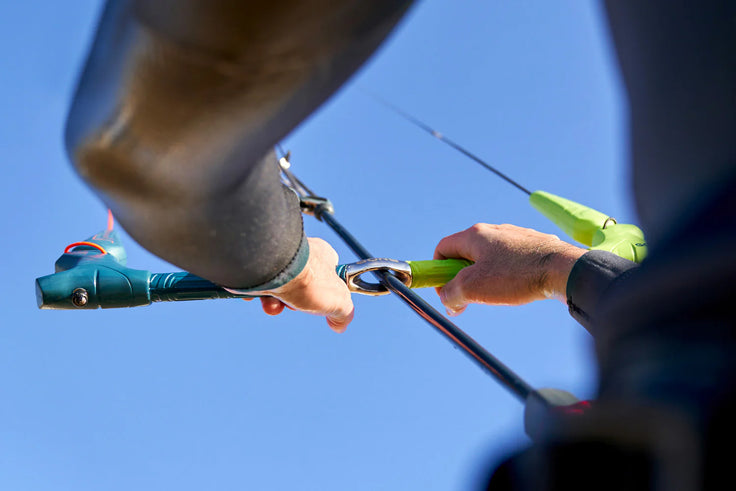
Ensure the red side of your bar is on the left.
Confirm that your chicken loop is correctly connected to your harness.
Verify that your safety leash is properly attached.
A connection error or crossed line can make the kite uncontrollable from the moment it leaves the ground.
Assess your environment
Before launching:
Make sure you have a clear area downwind.
Check that no one is standing inside your wind window.
Stay well away from obstacles such as swimmers, vehicles, buildings, trees, rocks, and other hazards.
Assess the wind conditions and make sure they are appropriate for your skill level.

Position the kite with an assistant
Ask an experienced kitesurfer for assistance.
The assistant should:
Turn the kite over if necessary.
Hold it by the leading edge.
Keep one wingtip resting on the ground.
Position the leading edge facing the wind.
Maintain control of the kite until you give the signal.
The assistant must never release the kite until you clearly indicate that you are ready.
Perform one final check
Once your assistant is holding the kite:
Check again that all lines are perfectly clear.
Make sure no tangling appears while positioning the kite.
Recheck all line connections.
Verify that the chicken loop is properly locked.
Confirm that the safety leash is connected.
Make sure no line is wrapped around the bar.
This final inspection helps identify any mistakes that may have occurred after your initial setup.

Position yourself correctly relative to the wind
Proper positioning in relation to the wind is essential for a safe launch.
Gradually move upwind.
Keep the bar in a neutral position without pulling on it.
Slowly apply tension to the front lines.
Position yourself so the kite sits exactly at the edge of the wind window.
How do you know you're in the right position?
You are correctly positioned when:
The canopy is fully pressurized.
The kite is no longer flapping.
The lines are tensioned without excessive pull.
The assistant does not feel significant load.
The kite remains stable at the edge of the window.

Give the release signal
Once all checks have been completed:
Make eye contact with your assistant.
Clearly confirm that everything is ready.
Give the release signal.
The kite should lift smoothly from the edge of the window while remaining under control at all times.
Avoid sending the kite aggressively to the zenith immediately after launch.

Prepare for landing
Before landing your kite:
Identify a clear landing area.
Make sure an experienced kitesurfer is available to assist you.
Clearly communicate your intention to land.
A tap on the top of your head is a widely recognized signal requesting assistance for landing.
As with launching, your assistant must understand the procedure and know where to stand, but it is your responsibility to guide the kite toward them.
Bring the kite to the edge of the window

Have the assistant secure the kite
When the kite comes within reach:
The assistant should:
Firmly grab the leading edge.
Immobilize the kite.
Maintain full control until you have secured the entire system.
Never release or disconnect your equipment until the assistant has complete control of the kite.

Secure the equipment
Once the kite has been secured:
Walk slightly toward the kite to create slack in the lines.
Disconnect your chicken loop if necessary.
Immediately secure the kite with sand or another suitable weight.
Wind up and store your lines neatly to prevent tangles.

Never launch or land alone during your first sessions. Self-launching and self-landing techniques should be reserved for experienced riders and only when necessary. Even with experience, assisted launches and landings are always safer.
Never entrust your kite to an untrained person.
Always check your line connections and safety systems.
Perform one final inspection to ensure all lines are perfectly clear before launching.
Verify that your chicken loop and safety leash are correctly connected.
Make sure no line is wrapped around the bar.
Position yourself correctly relative to the wind so the kite sits at the edge of the wind window before giving the release signal.
A safe session starts with a safe launch, and ends with a controlled landing.